Showing posts with label future of marketing. Show all posts

Friday, 17 February 2017

The Current State of Content Marketing (infographic)


The Current State of Content Marketing (infographic)

Businesses know that they need to attract customers to their websites so they can sell more goods and services online. Some of the most recent data shows that consumers in the United States spend over $808 billion per year online. If your website doesn’t convert visitors into paying customers, then you’re potentially missing out on a huge amount of money.

You have a few options when trying to bring more people to your site and convert them into customers. Content marketing, however, has become one of the most effective opportunities. With content marketing, you can improve your brand’s image, educate buyers about your products, and improve your position on search engine page results pages, or SERPs. You also get to control your marketing costs, which is nearly impossible for companies that rely on pay-per-click advertising.

Marketing professionals already know that content creation offers several advantages that can help their clients build their brands and earn more money. Review this infographic created by CopyPress to learn what marketers, business owners, and content creators think about the current state of content. It quickly becomes obvious that professionals understand that good content creation is an essential tool for improving website traffic and conversions. If you aren’t putting some of your time and money into content marketing, you’re putting your business at a disadvantage.

The Current State of Content Marketing (infographic)


Monday, 19 December 2016

How you can overcome the biggest future challenges of ecommerce


Okay, it's time.
It's time to let go.
Santa is busy sorting out all those orders you've taken.
Or at least that is every online store owner's Christmas wish.
Wouldn't it be great if some plump old Norweigan dude actually offered to magically manage the fulfilment of all of your Christmas sales!
Thanks, old boy.
The week before December 25 signals the impending end of the online silly season mayhem (well, until the madness of Boxing Day Sales).
There's not much you can do now. It's time to let that crippling anxiety fade. Take a deep breath, send the last batch of those arrive-by-Christmas-Eve orders, and pour yourself a well-earned festive beverage.
Just take it easy, though. You don't need this kind of ecommerce post-Christmas sales hangover...
As December draws to a close, you have done all you can to maximise your biggest period of the retail year.
It's time to change your focus to a brand spankin' new year of online retail possibilities (and the future challenges of ecommerce as well).
While your competitors and their teams are busy chomping down on turkey, gorging out on pudding, and drowning in festive Champagne - I want to help you start the new year as a lean, mean, repeat-sales-generating machine.
To get you a head-start on the rest, I've rounded up 10 ecommerce industry experts and asked them all to pinpoint the biggest challenges facing online retailers in the next 12 months, and what you need to do to make next year the best one yet.

Short On Time? Your Skim-Read Summary: 

Too busy to read the whole thing? We get it: logistics, synergies, KPI's - all that stuff. Here's the skim read version. You really should read the whole article though...
You can click on the dot point that takes your fancy and head straight to the relevant section. 
  • #1. Catalin Zorzini
  • #2. Gai Le Roy
  • #3. Brian Goulet
  • #4. Nathan Manning
  • #5. Eric Bandholz
  • #6. Brian Dean
  • #7. Andrew Youderian
  • #8. Todd Atkins
  • #9. Hannah Stacey
  • #10. Adrian Wakeham
  • What you need to do to stay ahead of the chasing ecommerce pack

CATALIN ZORZINI

Founder - Mostash Content Agency

Owner - Ecommerce Platforms

"The evolving customer profile is one of the biggest challenges most ecommerce managers are going to encounter in 2017 and will continue to be for years to come.
Customers are well informed, and they receive information from various sources. Retailers can’t convince someone to buy a product without the customer opening up a few comparisons and reviews. They can also go into brick and mortar stores to test, compare, view pricing and even scan product bar codes to see the best offerings throughout the entire internet.
In addition, most customers want everything served to them on a silver platter. If you’re selling online, your customers expect cheap (or free) shipping, constant availability and fast delivery. With the daily deal and Amazon world in full effect, people think it’s silly to pay full price for anything. This will affect your margins if you’re not able to develop a hardcore group of loyal repeat customers."

Your Strategic Ecommerce Advice for 2017

You need to embrace the competitive landscape of your niche. Be the brand that helps your customer research, compare and contrast. Find a way to earn the trust of your customers.

GAI LE ROY

Director Of Research - IAB Australia

"The biggest challenges today & past 2016 are still found in attracting, teaching and keeping the right people. Finding qualified staff that you can retain is so difficult in the current environment, and the ecommerce industry will stop for nobody.
Marketers in most industries, particularly in ecommerce, share the huge challenges of straddling more roles, & needing more skills than ever before.
A strong ecommerce marketer needs a high level of knowledge about brand, customer, data, user experience, the global marketplace & technology.
These employees are exceptionally difficult to find. And they don’t come cheap. If you want to retain an ecommerce pro for any length of time, a strong workplace culture and structured training and development programs are a must.
You need to continually re-skill and keep up to date with changing trends. A reverse mentoring program makes so much sense for an online retailer. You and your team can learn new skills from your specialist team members, and they develop managerial and leadership skills in return."

Your Strategic Ecommerce Advice for 2017

Be proactive with recruitment. If you find a superstar ecommerce digital pro that fits your culture, do whatever you can to get them on board, and design a plan to keep them (even if you don’t have an existing role set, these people are rare - you can’t miss out).

BRIAN GOULET

Co-founder and CEO - Goulet Pens

"Competition is fierce in all forms of business, but the rate at which large-scale e-commerce discount retailers are coming about is concerning.
As Seth Godin says, “The problem with the race to the bottom is you just might win.”
If you focus on commodities, discounting, promotions and other easily copied ways of doing business, someone (Amazon, Massdrop, Jet, and a slew of others) will undercut you every time, and steal away your customers if there isn’t any established loyalty.
That’s why content is so important. If you prove to your community that you know your stuff, you care about them, and you serve them well, they will support you through thick and thin because you’re looking out for their interest in the long-term.
If you’re in a niche industry like I am (fountain pens), this is crucial. The big discounters don’t care if they’re selling pens, diapers, or alarm clocks, as long as they move product.
If you’re niche, you have to play by different rules than the big guys do. What’s the one thing that Amazon will never have? Me, my team, our skills. Building upon our personal brand and efforts, we’ve created loyalty that feels personal and unique, because it is."

Your Strategic Ecommerce Advice for 2017

Play the long game. Create content that establishes your authority as the #1 in your niche.

NATHAN MANNING

Co-founder and Tribal Elder - Gorilla 360

"There’s too many options! You need to work out the best way to spend your time.
As the landscape continues to evolve, you need to be constantly aware of the biggest impact a marketer can make with the smallest amount of effort. There are so many different marketing and promotional tactics available to an ecommerce brand. The best professionals prioritise the highest value areas that maximise the company’s internal resources.
Experiment and play without devoting huge costs. Testing, strong consumer connections, and data analysis will offer huge opportunities to those continually focussed on innovation.
Those businesses most willing to adapt to change, innovate and grow quickly will succeed.
We need to find more innovative ways to do retail. Continual analysis and re-invention of your service offering, supply chain, and marketing channels will deliver agile organisations huge opportunities.
The dominance of global players like Amazon, Alibaba, eBay and your industry’s big box equivalent often set the agenda for the market at large, and because the online environment changes so swiftly, unforeseen things are now the norm. You need an appropriate culture to adapt to this change.
This is often easier with smaller, newer companies, but it’s just as important for larger corporates to position themselves for the future."

Your Strategic Ecommerce Advice for 2017

Focus on fewer activities and find the highest priority marketing tactics that will drive the most revenue. Don't get caught up in the bright lights of the shiny new acronyms and jargon. The next big thing in social media, virtual reality, or video marketing can be a big, expensive, wasteful distraction from the most important thing for any growing ecommerce business. Engaging customers and generating/nurturing interest in products, services and experiences is where you need to invest your time and effort. 

ERIC BANDHOLZ

Founder and CEO - Beardbrand

"The world is a crowded place and in a matter of months, there can be new competition popping up.
Granted - every business is different, but to stay ahead of your competition, you need to build barriers and walls. Those barriers are intimate relationships with your customers which have been built on a foundation of trust.
Trust is developed by delivering on expectations, educating the customer, and building intangible bonds that can’t always be tracked. The intangible bonds are all part of your branding. The more you deliver for the customer, the higher the barrier is - and the less likely your customers are to shop around."

Your Strategic Ecommerce Advice for 2017

Loyal customer relationships are your sustainable competitive advantage. Established trust is your most valuable competitor barricade. 

BRIAN DEAN

Founder - Backlinko

"The biggest challenge?
Dominating social media.
If you look at ecommerce sites that are defying the odds and beating Amazon, they usually have a huge social media presence (and most importantly) following.
Just look at Grace & Lace, who appeared on Shark Tank last year. In 2013 they did $2.8 million in sales. Their secret? They crush is on Pinterest."

Your Strategic Ecommerce Advice for 2017

Focus on one social media channel and dominate it. Then bring your audience back to your site.

ANDREW YOUDERIAN

Founder - eCommerce Fuel

"You need to know how to get people excited about your product and position it in a way that generates genuine interest and word-of-mouth buzz.  
It's an old concept, but the best marketing is word-of-mouth referrals from trusted friends and family.  
As attention gets harder to earn/buy online, being able to foster trusted referrals will be crucial for future ecommerce success."

Your Strategic Ecommerce Advice for 2017

Find a way to activate and deploy your loyal customers as recruiters. Social proof is both inexpensive and effective. 

TODD ATKINS

Australian Sales manager - Braintree Payments

"Providing a frictionless purchasing experience is critically linked to increasing conversions.
If you can reduce and condense the checkout ‘experience' to make it seamless, you have a simple and sustainable way to ensure you’re maximising sales.
The technology is ready and available to help us improve the checkout experience right now. Specifically - consider creating e-wallets, or at least give repeat customers the chance to save their payment details securely for a frictionless purchase experience.
Other features like social commerce, tokenization, stored payment methods, one-touch mobile payments and additional payment methods (Apple Pay, Bitcoin etc.) are one-off additions to your service that can make your customer’s shopping experience easier."

Your Strategic Ecommerce Advice for 2017

Don’t neglect the checkout experience. You can increase your conversion rate here dramatically with a few small changes. You need to make the most of these hot prospects before you invest in optimising other areas of the buyer journey. 

HANNAH STACEY

Marketing Manager - Ometria

"It might sound like a cliche, but for me, it's saying the right thing at the right time. We’re still at a stage where most online retailers are sending the same, undifferentiated marketing messages to all of their customers and prospects, no matter where they’re at in their customer journey.
This doesn't make a whole lot of sense when we know the most effective marketing is relevant to the customer’s current stage in the buying journey.
The great news - tech is becoming more democratised. The ability to gather data and segment your customers based on their purchasing and interaction data is available, and now the options for targeting them are expanding."

Your Strategic Ecommerce Advice for 2017

Personalise. Develop specific content experiences to help customers convert to the next stage of the buyer journey process. Explore the technology available that allows you to send the right message to the right customer at the right time. 

ADRIAN WAKEHAM

Business Development Manager - Power Retail

"This may be a little controversial, but in a world where more dollars are being shifted from traditional mass media into tightly managed, highly targeted digital campaigns with hard performance metrics in place - remember this all leads back to a human-to-human transaction in the end.
If you have a physical store, the majority of your online marketing efforts will result in the sale occurring in an offline environment.
My advice is nothing new: take the most holistic approach to your marketing your budgets will allow.  
Remember, online impacts offline, and offline impacts online.
Understand where your customers both exist, and engage in conversation, and use complementary marketing channels to drive a better overall result.
For example, should you sell a mass commoditised product; despite the potential reach of online, nothing can beat network TV for quickly reaching a critical mass of customers."

Your Strategic Ecommerce Advice for 2017

Online and offline retail are irresistibly intwined. One cannot be considered without the other. Don’t discount traditional marketing channels. If awareness is your goal, and you need it quick - paid advertising is still the best way to go. 

What you need to do to stay ahead of the chasing ecommerce pack

Create a best-in-class shopping experience or lose a price war to Amazon 

We all understand the importance of customer service, but we are struggling to offer truly helpful, seamless and quality customer experiences online.
Now, more than ever, the customer is in control. They aren’t prepared to put up with difficulty – it’s just too easy to click through to a competitor’s site and buy elsewhere.
How do we improve ecommerce customer service?
The answer is not a generic automated helpdesk popup! It’s not!
It’s hard work. Retail marketing professionals have to get proactive and skill-up. Ecommerce marketing is a broad discipline, and while it's still crucial to have specialist expertise in one area, you need to understand how blogging, SEO, social media, PPC, email and CRO work together in one integrated retail strategy.
To develop a truly excellent, best-in-class customer experience, we need to understand how to use the technology our audience prefers. That might mean taking a course, researching online, consulting a mentor, or attending new events and meetups to keep your brand, and your career, ahead of the fast-chasing pack.
More practice, continual testing, better education, and a cultural desire to change, experiment and innovate will get you there faster.

“Digital” doesn’t matter anymore

Your target audience is what matters. What they care about is what matters. If your customers love to buy shoes, they love to buy 'em anywhere. Whether they decide to buy in store or online is becoming secondary.
The term ‘digital marketing’ is losing relevance. Digital stuff isn’t the shiny new thing that people under 30 can slot into their resume and give themselves an advantage. Let’s face it, in online retail - digital marketing is just marketing.
Your digital strategy?
That’s just your marketing strategy.
The gap between online and offline is closing – with ‘bricks and mortar’ brands becoming ‘clicks and mortar’ brands, and pureplay retailers beginning to experiment with print and physical experiences.
The marketing pro’s with the best understanding of marketing strategy are the most sought after. You need to learn how to understand, find, attract, convert, and retain a target audience.
If you can learn how to help an ecommerce company build a community of repeat customers, you’ll an invaluable asset for any brand’s marketing department.
If you focus on becoming an expert in any one channel or skill, you’ll still be a valuable commodity. But with the rapid change in ecommerce marketing, you need to add this big picture understanding to your specialist expertise if you want to future-proof your career development. 

Get back to marketing basics

Amidst all the buzzwords, acronyms and ‘gamechangers’, regardless of the new technologies and channels available, marketing hasn’t really changed.
The concepts and strategies that have worked for decades still hold true today.
It’s your customer's needs and wants that have changed with the times.
Turn the focus around to your target audience. Identify your customer, divide them into segments, and zero in on your niche as much as possible. Only when you understand your target inside out should you think about selecting the best channels to reach them.
Don’t be afraid to change your strategy if it isn’t working. But don’t place your fate in the hands of your technology. Too many marketers waste their budgets on expensive add-on ecommerce technology, software and applications before optimising their customer's experience. There's no point paying more to bring more shoppers to a site that won't convert.
Focus on creating every piece of content you need to turn a shopper from someone who knows absolutely nothing about your brand, into a loyal repeat customer. Once you've developed that customer journey, you can invest in technology that helps you attract, convert and retain more users to your repeat-customer-generating process.

Analytics matters

If you do nothing else, make analytics and the information about your customers that you can derive from them a priority.
Whether it's Google Analytics, your CMS provider or another analytics application, learn how to understand how to find and interpret key metrics.
Set conversion objectives specific to all of your content and make your decisions based on the result.
Regular data analysis allows you to monitor the progress and the performance of your website and other online channels, giving you a real insight into your audience’s behaviour. You need to optimise your ecommerce marketing based on real evidence. 

Invest in quality online store software

Over the next 12 months, many ecommerce will be looking at their outdated systems and technology and looking to upgrade - to avoid the situation our friend above finds himself in. It's a daunting problem, filled with pangs of anxiety and crippling risk.
Unfortunately, your online store platform can be a make-or-break proposition. Some legacy systems (particularly custom built options) can handicap your growth potential. Even though the huge outlay on newer technology may seem hard to justify - you need to give yourself the best chance to achieve your goals and dreams.
While we recommend Neto, Shopify and Magento to our clients and partners (depending on their specific needs), there are a variety of software options available that could make your life and your ecommerce operations, so much easier.
If you'd like a more detailed comparison, we've prepared a quick snapshot in this article titled:

Ecommerce CMS comparison guide: How to choose the right platform for your online store

(You should also check out our contributor, Catalin Zorzini's fantastic blog Ecommerce Platforms. His team are the ultimate resource on all things ecommerce technology.) 
Not all ecommerce platforms are a good fit for you. The ‘best ecommerce platform’ is the one that helps you make the most profit.
For organisations with little or moderate technical expertise and limited budget, this choice is a big deal. Don’t be afraid to make the investment to update your site.
If it’s the right decision, make it. The costs will come back to you and more if you commit to the long term.

And one last piece of advice for your personal retail marketing career...

Keep learning to develop all-round digital marketing skills

Take a course, read a book or download a video series. The best bit about the online marketing industry is the availability of easily affordable and accessible info.
User experience design is a particularly valuable skill for the modern marketer. Even an elementary knowledge of web design, coding and conversion rate optimisation will give you a massive strategic advantage.
Even if you aren’t on the ground floor implementing, you still need to be able to understand the possibilities open to you. If you don’t have a thorough grasp of the capabilities of the technology you are using, it will be more difficult to work with others to build a winning ecommerce strategy for your organisation.
The best online shopping experiences win out in the long term. Profitable market leaders have the best user experiences. If you understand how to improve your brand's UX, you can implement valuable strategic change.


Source

Monday, 12 December 2016

Content Shock: Why content marketing is not a sustainable strategy

content shock
By Mark Schaefer
This post will demonstrate in simple economic terms why content marketing — the hottest marketing trend around — may not be a sustainable strategy for many businesses.
Like any good discussion on economics, this is rooted in the very simple concept of supply and demand. When supply exceeds demand, prices fall. But in the world of content marketing, the prices cannot fall because the “price” of the content is already zero — we give it away for free. So, to get people to consume our content, we actually have to pay them to do it, and as the supply of content explodes, we will have to pay our customers increasing amounts to the point where it is not feasible any more.
Paying people to read our content? Does that sound crazy? But you’re already doing it. Let me explain.

You are “paying” people to read your content

When I got my very first company laptop computer (a brick-like device called a GRID) I eagerly plugged it into the phone line and took my first step on to the Internet with that unforgettable AOL screech-and-hiss of a connection sound.
I explored the meager content offerings and found a file with NASA photographs. I clicked on a link and over a period of 10 minutes, a photograph began to download onto my screen.
This was a tremendously exciting breakthrough and I called out to my wife and children “Quick! Come see this! I’m getting a photograph right through the telephone line!”
At that time, the seemingly miraculous ability to access a piece of content — any content at all — was a thrill. We were starved for content and stared with wonder at literally anything we could obtain through this new electronic conduit.
Fast forward to 2009, the year I became a serious content creator. At that point, the web was still a relatively uncrowded “content space.”  Red Bull was a beverage company, not a media company, Chipotle was making burritos, not clay-mation films, and there were roughly one-third as many bloggers as there are now … not to mention podcast producers, video-makers, Pinterest pinners, Facebook posters, and Instagram photographers.
Let’s say that in 2009 I spent five hours a week creating content that would be consumed by my blog readers. This was a happy time because not only was the content competition weak, consumption was dramatically increasing too — more people were piling on to the web, on to social media, and on to mobile devices that extended the amount of time each day they could consume content.
For argument’s sake, let’s value my time at $100 per hour. So with 5 hours of content creation in 2009, I was “paying” my readers $500 in my time to consume my content each week. The value I was receiving in return from new business connections far exceeded that investment, so this made good economic sense.

The content model falls apart

Let’s fast forward one more time to 2014 and look at the two factors that impact the economics of content marketing — the amount of content available and the amount of content consumed (supply and demand).
Of course the volume of free content is exploding at a ridiculous rate. Depending on what study you read, the amount of available web-based content (the supply) is doubling every 9 to 24 months. Unimaginable, really.
However, our ability to consume that content (the demand) is finite. There are only so many hours in a day and even if we consume content while we eat, work and drive, there is a theoretical and inviolable limit to consumption, which we are now approaching.
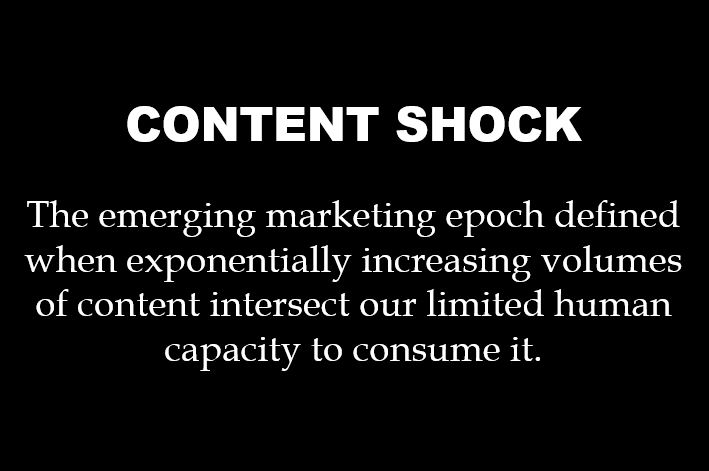
This intersection of finite content consumption and rising content availability will create a tremor I call The Content Shock. In a situation where content supply is exponentially exploding while content demand is flat, we would predict that individuals, companies, and brands would have to “pay” consumers more and more just to get them to see the same amount of content.
And that is exactly what is happening.
Content Shock definition
I know that you are under a barrage of distractions from increasingly amazing content. For me to simply maintain the “mindshare” I have with you today on this blog, I am going to have to create significantly better content, which of course will take significantly more time. I will probably have to pay Facebook and others to give you a chance to even see it because of this content competition for attention.
I will have to “pay” you at much higher rates just to keep the same number of readers in 2015 that I had in 2014.
Let’s look at this in graphical terms:
content shock
According to Nielsen and other sources, the amount of content we consume on a daily basis has grown from two hours a day in the 1920s to nearly 11 hours per day today. Propelled by mobile devices, the average amount of content we consume on a daily basis has gone up by two hours a day just in the last three years!
How much higher can this go? 12 hours a day? 13? Who knows. But there is some limit.
On the supply side of the equation, the amount of information on the web is expected to increase by 500 percent (conservatively) in the next five years. If you can imagine how big the Internet is, in the next five years, we are going to have five of those.
Do you think it is going to be a little more difficult to be successful in content marketing?

Content Shock is here

This upward trend of content consumption is not sustainable because every human has a physiological, inviolable limit to the amount of content they can consume. I believe as marketers, we have been lulled into a false sense of security thinking that this consumption trend will continue to rise without end. That is simply not possible. The Content Shock is coming and I believe we are beginning to enter the danger zone now.
Every single content producer, every marketer, and every business is standing at this same cliff to some degree, and the implications are vast.

1) Deep pockets win

First, as each new media channel has emerged, it is originally fueled with crude “local” content but the eventual winners are the content creators with the deepest pockets. When television started, for example, the airwaves were filled with local programming (kind of like the bloggers of their day!) who created cooking shows, game shows and variety shows using local talent. Today, there is virtually no “local” content consumed on TV, as the corporations have taken over.
If you examined a list of the most popular YouTube videos five years ago, they were “locally-produced” home movies. Today the most popular videos are dominated by big names and big brands producing slickly-produced films and music videos.
Over time, the low budget content producers are eased out of the consumer mindshare as we “pay” more for their attention.
The idea that “great content rises to the top” is over. We are in an era where advertising, promotion, and distribution strategies may eclipse the importance of the content itself.

2) The entry barriers become impossibly high

We see the deep pockets trend occurring in even the smallest market niches. The companies that can overwhelm the market with content can effectively raise the entry hurdles for competitors and maybe even block them out of key search results entirely. Essentially, winning marketers create Content Shock for their competitors!
So the second implication of Content Shock is that barriers to market entry will become impossibly high for many businesses. In 2009 it was pretty easy to start a blog and get a few readers because there just were not that many content producers around. Supply was low, demand was high. How does a small company build an audience today from a standing start in this era of Content Shock? That task is getting more difficult every day.

3) The cost-benefits flip 

Finally, the economics created by Content Shock will eventually force many content marketers to adjust their priorities and tactics.
If I was “paying” my readers $500 a week in 2009, I am probably paying them $1,500 per week now because of the pressure to create more and better content that will keep their attention. Next year, it might be $3,000 per week — just to MAINTAIN my readership in the face of the Content Shock. At some point, the amount I am “paying out” will exceed the amount I am bringing in and at that point, creating content will not be a smart business decision for me and many other businesses.
A few months ago, Facebook provided a glimpse of the economics of Content Shock in its business blog when it bluntly stated that the exploding amount of content competing for views in users’ news feeds is making it increasingly difficult for brands to get their content delivered organically to their fans.
According to research by AgoraPulse, the average organic reach on Facebook for a brand declined by more than 30 percent in the last 12 months. That is a cataclysmic change. Why? Facebook explains that the average user can see more than 1,500 stories in their newsfeed. That is simply too much.
So, they need to severely edit what we see. Starting with brands. And that is Content Shock in action before our eyes. There is too much stuff. So, one way or another, the cost of being successful on Facebook is going up.
And so, it begins. The global warming of content marketing is in view.
Eventually, a “cover the world with content” marketing focus will not be a long-term sustainable strategy for many businesses.

So where do we turn?

Of course content marketing is far from over. How and when the “shock” occurs will vary greatly by business, by industry, by content saturation in a niche, by a lot of other factors. For some the crunch might be years away, for some it is happening now.
Similarly, from the perspective of a consumer, this trend is GOOD NEWS. Companies competing for limited consumer attention means more choice and better content. The impact of Content Shock does not result from consumer “information overload.” It comes from the business implications of fighting through overwhelming content density for a finite level of attention. There’s a big difference.
In the history of marketing, there have always been new frontiers enabled by technological breakthroughs and the visionaries who act first. What is the next area of innovation we need to pioneer when the implications of Content Shock become unbearable?


Monday, 28 November 2016

Social Influencer Marketing on the Rise: New Research


Is your company considering influencer marketing?
Wondering how social influencers might fit into your overall marketing strategy?
Many businesses aren’t sure if influencer marketing is a fit for them, or even how to go about pursuing a relationship with potential influencers.
In this article, you’ll discover why social influencer marketing is useful, where brands are running influencer campaigns, and which tactics are most successful.

#1: Social Influencer Marketing Campaigns Are on the Rise

According to the 2016 Influencer Marketing Report released by Chute (a user-generated content marketing solution) and Thuzio 360 (a social influencer procurement platform), 66% of the more than 200 marketing professionals surveyed used social influencers as part of their marketing strategies in 2016.
Of these, 80% report doing so because they want to reach different audiences on social networks and 70% want to reach smaller niche audiences that brands sometimes have trouble identifying and connecting with. Looking ahead, 40% of respondents not currently using social influencers plan on implementing a strategy in 2017.
Reaching new audiences isn’t the only reason social media marketers are turning to influencers for help, however.
In their February 2016 report, Influencer Marketing for U.S. Brands: The Platforms to Watch, and the Best Ways to Work with Creators, eMarketer found that one of the top reasons companies use social influencers is rising concerns about ad blocking and ad avoidance. This fact is bolstered by Omnicom Media Group‘s July 2016 study that showed 69.8 million Americans will use ad blockers in 2016, a rise of 34.4% from 2015.
This is where social influencers come into play. With authenticity being such an important part of a company’s brand image on social media, marketing departments are turning to trusted online personas to get their products and messages out to the consumer. After all, are you more likely to pay attention to a message from a real person, or a pop-up or pre-roll ad that keeps you from consuming the content you want?
Consumers are pushing back against invasive Internet advertising.
Celebrities are often the first people thought of when discussing social influence; however, virtually anyone with a unique shtick can amass a large, loyal following that gives them social media influencer status.
Takeaway
Marketers are having to get more creative for their messages to be seen by consumers. In today’s crowded social network ad environment, that’s easier said than done. With the rise of programmatic buying, the competition for ad space is heating up and, depending on your industry, getting more expensive.
Using social influencers is a great way for companies to differentiate themselves. The influencers come with built-in audiences that marketers can tap into, saving some time and money typically spent on market research and audience targeting. The flipside of that coin, however, is that one of the biggest hurdles social media marketers report is identifying influencers to work with.

#2: Ongoing Influencer Ambassadorships Are the Most Effective Tactic

While brands often manually search for potential influencers to work with, doing so is a time-consuming process and doesn’t guarantee a good match. Often one of the first factors companies look for when finding social influencers is how large their audience is.
However, the February 2016 eMarketer.com survey found that an influencer’s engagement numbers are a better indicator of success than the size of his or her audience; specifically total reach, audience demographics, views and/or impressions, click-throughs, and the number of likes and comments on social media posts.
Instagram leads the pack when it comes to social influencer marketing.
Having said that, engagement numbers depend on the social network being used. The Chute and Thuzio 360 study found that the overwhelming majority of marketers who use social influence marketing do so on Instagram (89%), while Facebook and Twitter were tied for second with 70% each.
It’s not just how or how much an influencer engages with his or her audience, it’s also a question of why the audience engages with the influencer. The Influencer Marketing Manifesto, written by TapInfluence and Altimeter Group in July 2016, showed that out of the 1,753 influencers surveyed, 71.2% say their follows remain engaged due to the influencer’s authenticity.
Interestingly, only 58.9% of respondents reported that their followers were engaged because the influencer interacted, listened, and responded online. This is a slight shift away from the emphasis that brands put on the importance of interacting directly with consumers online.
Why social influencers are effective.
The same study by TapInfluence and Altimeter Group also found that using social influencers for ongoing ambassadorships is the most effective marketing tactic, according to nearly 71% of the 102 marketers surveyed. Product reviews came in second with 66.7% of the respondents finding them worthwhile. Brand mentions (53.9%), event coverage (52.9%), and sponsored content (50%) came in third, fourth, and fifth, respectively.
These results lend credence to the idea that consumers look for and appreciate authenticity when it comes to influencers. If a person continues to use a product, one could assume that said product is a good one and worth checking out.
When a product is reviewed, there’s always a slight chance that the reviewer may not be entirely honest about his or her opinion to keep the brand happy and willing to continue the relationship. It’s a simple fact that while most companies say they want honest reviews, if an honest review doesn’t paint the brand in a positive light, it could hurt business.
While the assumption is that social influencers are being authentic, there’s always a possibility (regardless of how slight) that their opinions are swayed by the desire to continue the business relationship.
Ongoing ambassadorships show a level of dedication on the part of the influencer.
Takeaway
There’s more to incorporating influencer marketing into a strategy than selecting a well-known individual to interact with your brand in some way on social media. If your social influencer does not have a strong, loyal following on the social network where your target audience is found, your strategy won’t be as successful as it could be.
Although it’s been around for a few years and is gaining popularity, many marketers still shy away from using influencer marketing because they simply don’t know where to start.
In fact, 75% of respondents in the Chute and Thuzio 360 study stated they haven’t implemented social influencers in their social media marketing because they don’t know how to start such a program. This includes not knowing where or how to find the right influencers for their brand.
A number of firms have cropped up to act as “matchmakers” between brands and social influencers. Using one of these services could be a great way to get a foot in the door and learn what goes into finding the influencers who will benefit your brand the most.

#3: Measurable ROI on Influencer Campaigns Remains Elusive

Measuring the success of social media marketing campaigns has always been a challenge for marketers. New tools and methods have surfaced that take some of the guesswork out of it and onboarding decision-makers has gotten easier now that the usefulness of social media has been demonstrated; however, the need to definitively measure ROI has not gone away. It’s no different with social influencer marketing.
There's room for improvement when it comes to influencer marketing.
There’s room for improvement when it comes to influencer marketing.
In fact, 80% of the marketers surveyed for the August 2016 Chute and Thuzio 360 study said that measuring ROI is an aspect of influencer marketing that needs improvement. Sixty-six percent say they wish they had better options for tracking influence and 60% wish it was easier to discover influencers.
With social influencer marketing, you’re not solely dealing with the behavior of your social media team manning the accounts. You now have a third-party representing your brand on social media and the results of this relationship can be harder to predict and control. There’s also the fact that you’re dealing with an individual who is a brand in his or her own right; one who is used to having creative control over what he or she posts.
Crowdtap‘s November 2015 study, The State of Influencer Marketing, found that 77% of the 59 social influencers surveyed stated that they’re most likely to work with brands that grant them creative freedom over what they post. This lack of control can put marketers at a significant disadvantage when attempting to measure ROI and make any necessary strategy adjustments to improve it.
Creative freedom is a must-have for social influencers.
Takeaway
If a brand wants (or needs) to have strict control over the activities that are heavily counted when calculating the ROI of their social influencer marketing campaign, it’s important to know how much creative freedom the influencer wants. They also have a reputation to uphold, and not being able to control the types of content they post can be detrimental (or even fatal) to the business relationship. If this happens, a brand is more likely to have difficulty finding influencers willing to work with them in the future.
Conclusion
The insights above show why social influencer marketing is useful, where it best fits into your overall marketing strategy, and the importance of setting expectations for such a business partnership.
Social influence marketing is using influential people on social media networks to help brands build relationships with new and different audiences.

What do you think? Are you more inclined to pursue influencer marketing? Share your thoughts in the comments below.