Showing posts with label how to keep focus. Show all posts

Tuesday, 21 March 2017

3 Scientific Reasons Clutter Can Stress You Out


Last spring, SUCCESS contributing editor Melissa Balmain embarked on a personal journey through the en vogue doctrine of neatness apostle Marie Kondo. Balmain might not have emerged a devout “Konvert,” but she did considerably reduce the clutter in her home, and gained a noticeable boost in mental and physical energy.
(For those who missed the height of the craze, the concept is fairly straightforward: Sort through every item in your home by category, and if an object does not “spark joy”—or at least have a necessary function—let it go. Kondo’s minimalism manifesto leads off boldly with, “I have summed up how to put your space in order in a way that will change your life forever.”)

Kondo’s method went mainstream in the U.S. after the English release of her first book, The Life-Changing Magic of Tidying Up, in 2014. In a New York magazine profile, Kondo explains that the first of her two titles on the art of organization (the follow-up, Spark Joy, published in 2016) was intended as a temporary solution for a lengthy list of clients in Tokyo waiting for personal consultations. Both titles reached the top of the New York Times best-seller list, Fox and NBC have a sitcom about her in the works, and in 2015 she was named one of Time magazine’s 100 most influential people. It’s safe to say that KonMari, as she’s known, is the Beyoncé of decluttering.
I began noticing copies of the small book with its cloudy blue watercolor cover appearing with increasing regularity on friends’ coffee tables, and even on the desk of a fastidious uncle with a profound love for his label maker. Instagram posts popped up of pristine coat closets and sock drawers with captions involving the word “Kondo’d,” which somewhere along the way had become a verb.

I frequently purge the contents of my apartment, priding myself on fitting all holiday decorations into one (slightly bulging) box and waging a ruthless war against errant office papers.


Personally, I didn’t think I had a need for Kondo’s methods. Already a self-proclaimed “anti-hoarder,” I frequently purge the contents of my apartment, priding myself on fitting all holiday decorations into one (slightly bulging) box and waging a ruthless war against errant office papers. I didn’t give much thought to the cause behind my unflagging impulse to consolidate, and crossed my fingers that my significant other would continue to find it endearing when I hid sponges out of sight under the kitchen sink.
But recently I found myself on an unexpectedly long layover with no reading material, and the cloudy blue cover was in my direct line of sight on a backlit rack of best-sellers. It was a validating read; Kondo and I share a mutual aversion to old receipts and unsightly sponges, and her folding technique is spot-on (though I didn’t quite buy the personification of my socks). What I found most interesting, though, was poking into Kondo’s background—a habit when it comes to authors I enjoy. I learned that feng shui (the Chinese philosophy of achieving harmony with your environment) had been a major influence in Kondo’s study of neatness, and she was intrigued by the concept of creating “psychological distance.” In theory, feng shui can help avoid mental crowding through the careful arrangement of one’s possessions, which naturally pairs with Kondo’s minimalist methods.

Throughout her books, Kondo asserts that our bodies experience a physical and emotional reaction to tidying up. And it made me wonder: What’s the neurological effect of clutter on your brain?

1. It can (literally) hurt to let go.

In 2012, researchers at the Yale School of Medicine found that when individuals with hoarding tendencies were faced with discarding an object of personal value, two regions of the brain associated with conflict and physical pain showed greater signs of activity, the anterior cingulate cortex and the insula (the same areas that produce nicotine cravings). The stronger the connection to the possession, the greater the resulting feeling of psychological discomfort or anxiety.
Although most people don’t experience heightened ACC/insula activity to that degree, we can all identify with the feeling in the pit of your stomach when you finally decide to toss that pile of ancient bank statements or a Dave Matthews screen tee that shrank in the wash half a decade ago (both casualties of my latest sweep).

2. It can elevate cortisol.

According to David W. Ballard, assistant executive director of the American Psychological Association’s Center for Organization Excellence, many adults “operate in a state of chronic stress.” For some, coming home to a chaotic physical environment prevents the body’s cortisol (aka the “stress hormone”) levels from naturally declining throughout the day.
A 2009 study published in Personality and Social Psychology Bulletin found that women who described their households as “cluttered” exhibited increased fatigue and depression with correlating high cortisol levels, and a research project by UCLA in 2012 saw a similar link. Cortisol is bad news for healthy brain activity, as heightened levels of the hormone can cause lasting negative changes in brain function and structure.

3. It can affect your ability to focus.

An excess of physical clutter can overload the visual cortex, competing for attention in your brain and interfering with your ability to focus and process information. You might not realize it, but an overflowing laundry hamper, kitchen table piled with papers and overflowing junk drawer can subconsciously be on par with a whining toddler, distraction-wise.
In a study by the Princeton University Neuroscience Institute, researchers monitored task performance when an individual was surrounded by organized versus disorganized stimuli; overall, subjects were more productive—and less irritable and distracted—in the clutter-free environment. This one is especially relatable; though admittedly I’m on the more neurotic end of the spectrum, I have a hard time doing anything at home before straightening up my entire living space.
The mess threshold differs for everyone (some even encourage embracing the clutter), and for those with “chronic” disorganization, joy is sparked by chaos itself. But for me, there are serious psychological benefits to making that monthly Goodwill run—and my sock drawer has never looked better.

Tuesday, 10 January 2017

Why You’re Always Tired and How to Get More Energy

And how to get more energy
You know what it means to be tired—it’s the desire to enter a vegetative state and not do anything remotely useful for yourself or the development of humankind.
Ever wondered why you’re always tired? There are a number of mechanisms that make us tired, and each one of them makes us feel a certain kind of exhaustion. But there are ways to fix it, too.

Sleepy Tired

This is a particular type of fatigue that makes you feel drowsy and heavy-headed once bedtime approaches. Because of melatonin, though, you can’t really avoid it, even if you had a fairly relaxing day and generally sleep well.
Basically, the more of this chemical you have in your system, the sleepier you feel. Your body produces melatonin following a pattern known as the circadian cycle. Barely any melatonin is produced in the morning and mid-day, but it starts to kick in between 8 and 9 p.m. and hits its peak between 1 and 2 a.m., at which point you really want to hit the sack. It stays at pretty elevated levels for about 12 hours, until around 8 a.m.
Why You’re Always Tired
Melatonin diminishes our ability to be alert and focused. That’s why our work schedules are generally structured around mornings and early afternoons, and much less in the evening.
But not everybody produces melatonin in the same intervals. Some might hit peak melatonin at midnight and feel perfectly refreshed waking up at 7 a.m., while others reach their highest melatonin levels at 1:30 a.m. and need to wake up at 8:30 a.m. to feel just as rested. This is called a chronotype, and it varies from person to person.
Science has speculated this is actually an evolutionary trait, because those who fell asleep later could stand guard over those who went to bed earlier.
Your body knows on a biological level whether it’s night or day by sensing how much light is in the environment. If there’s a lot of light, then it must be daytime; if it’s dark, it must be night.
Here are some tips that will help you get a good night’s sleep and ensure you are well rested in the morning:

1. Learn what your chronotype is.

Going to bed and waking up at your default hours will help you avoid restless periods when you can’t fall asleep because your body isn’t ready yet.
Why You’re Always Tired

2. Keep your work environment well lit.

This is especially relevant during winter times when the day is short. The extra light will delay the production of melatonin and allow you to squeeze in a bit more productive work time.

3. Try not to use smartphones or laptops before bed.

Screens in general make it harder for you to fall asleep because the light they emit happens to be in the same spectrum as daylight. Basically, they trick your brain into thinking it’s still daytime and will delay production of melatonin, making it harder for you to fall asleep.

Synapse-Fatigue Tired

Our brain is composed of billions of neurons, and it functions by sending information from one neuron to another. Neurons are connected through small gaps called synapses.
Why You’re Always Tired
So in order for information to pass from one neuron to the next, it needs to be carried across these synapses. The task of transporting information falls on neurotransmitters.
Imagine the whole thing as a biological shipping port.
Why You’re Always Tired
However, you have a limited amount of neurotransmitters. It’s easy to do stuff when you are rested since you have enough of them to process information. But once they are all used, you must wait for them to regenerate.
This is when you start to feel tired. Basically, your neurons get clogged up with information but don’t have enough neurotransmitters to send it to other brain cells. In this case, information processing grinds to a halt.
Why You’re Always Tired
That’s why you will reread the same book page for five minutes, or spend 30 minutes to write a two-sentence email.
Here are some tips to avoid mental fatigue and extend your productive time:

1. Be sure to take breaks.

After a prolonged period of concentration and work, the amount of neurotransmitters in your brain plummets, so taking a time out will help regenerate them and get you back on track.

2. Drink water.

Among its many functions, water stimulates the creation of neurotransmitters and will help you stay mentally sharp and creative while minimizing brain fog.

3. Prolonged exposure to a task will make you insensitive to it.

When you put your hand in cool water, there’s an initial temperature shock but it wears off within in a few seconds. A similar process applies to work tasks too, after a while you become “blind” and won’t be able to easily spot errors and mistakes.

I-Can’t-Make-Enough-Energy Tired

Another source of fatigue comes from your body’s inability to produce enough energy to function properly.
The way your body produces energy is a fairly complicated process, but a good part of it happens at the cellular level, beginning with your mitochondria, often referred to as the “power plants” of cells.
Why You’re Always Tired
The number of mitochondria in your cells is a variable figure. What happens is that your body creates only enough mitochondria as it needs to power up.
If you’re a sedentary person, then you have a lower of amount of mitochondria because you don’t need that much energy to function. But if you’re going through an unusually demanding day, then your body will struggle to keep up.
One of the best ways to gain more “power plant” cells is to exercise. Here are just a few of the ways working out will prevent you from tiring out so quickly:

1. Exercise is a very energy intensive activity for your body.

So in order to cope, it creates a lot more mitochondria in order to sustain the fuel demand. But those mitochondria also produce energy during regular, low-intensity activity. As a result, it takes you longer to tire out, and even when you reach that point, you’ll recover faster.

2. Besides producing more energy, exercise will also make your body more efficient.

Your muscles get better at extracting oxygen out of your blood when you exercise. Because of this, your heart, which is also a muscle, doesn’t need to work so hard to distribute oxygen to organs and muscles.

3. A moderate amount of light exercise will fire you up and improve your concentration and other mental abilities.

The emphasis really falls on the words “moderate” and “light”—anything more than that and you actually risk depleting your energy reserves.
Once you know what biological mechanisms drag you down, it becomes possible to work around them or improve them.


Friday, 16 December 2016

Ideas to Help You Become a Finisher


Too often, I find myself sitting down to accomplish something only to get sidetracked by something that I feel needs some attention.  A perfect example is a site that I’ve accomplished very little on because every time I go there to do something, I find something that needs to be tweaked on the site rather than creating the content that is so vital to the site’s existence.  Other times I sit down to write some content, and for some reason I just find myself staring at the screen rather than doing anything useful at all.  If you’ve had this happen, trust me, you’re not alone.  Come on in to find out some things to help you stay focused and finish your tasks.

Make a List of Items to Complete Before You Start

One of the biggest problems I personally face is that I sit down with a whole head full of things that I need to complete, and ultimately that creates a very scatter-shot approach to completing tasks.  When you don’t have a specific thing that you’re sitting down to accomplish, it’s very easy to sidetrack yourself on other items that might be more appealing to you.  As a programmer/UI person, I gravitate towards look/feel of things (ironic as I know this site isn’t the most beautiful thing on the web, but stay with me here) and so it’s easy for me to get distracted on trying to create cool looking responsive layouts, or finding new plugins for WordPress, or focusing on ad layouts, etc.  You get the point here – I have a ton of things I want to accomplish at any given time and if I don’t have a task list in front of me of what NEEDS to be completed, then I’ll tend to float off onto something that’s more appealing and ultimately less productive as the things that appeal to me are generally more trial and error and research driven.
I’ve listened to several courses in the past and read books on making the most of your time.  While every one of them have variations on the basic idea of creating and maintaining a list, the one constant is that most people do suggest you SHOULD have a list and you SHOULD actually use it!
My recommendation is to create a list of specific tasks that can be completed in a sitting – maybe two at the most.  The key is, if you create a list that has tasks that can actually be accomplished, chances are you’ll use it.  If you create tasks that are too large in scope, you’ll be frustrated and swing back to the days of old where you just take aim at whatever feels best at the time.
Here’s some task management software recommendations to get you started:  Free To Do List Software

Mind Mapping Can Free Your Mind

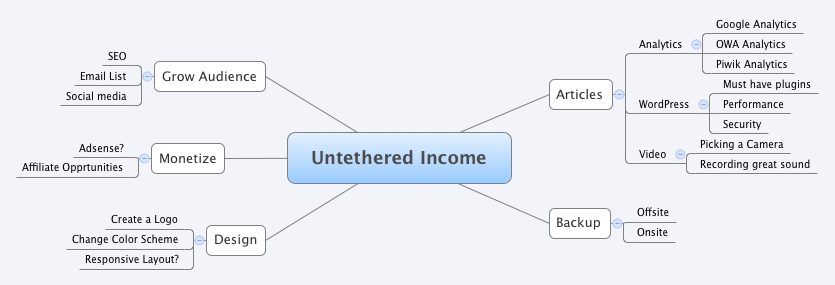
While I recommend using lists, one thing that I find extremely helpful is using something called a mind mapping tool.  If you’ve never heard of it, I’ve included a picture of one below.
Mind Map Example for Untethered Income

As you can see, it’s really just a way of extracting your ideas from your head and getting them out in front of you in a visual format.  As I mentioned in making your lists, it’s best to break your tasks out into smaller, manageable tasks.  A great way of breaking these things into smaller tasks is to mind map them out so that you can visually break them into bite size pieces.
Here’s a great article on mind mapping software – trust me, there’s more than what’s in this article, but at least this is a good start.  Recommended Mind Mapping Software.

Don’t Get Hung Up on the Software!

Ok, so this may sound stupid, but I’ve been a victim of this myself.  Don’t underestimate the power of the pencil!!!  I’ve definitely found myself getting lost trying to figure out software, or trying out 10 different applications just to see which one suits me best.  While that’s all fine and good, at the end of the day, if you spend more time screwing with the software than doing the simple task of managing your list, then you might as well break out a pencil and a sheet of paper and just jot down what you need to do, and draw your own mind map!  Remember, all this software is rooted in things that people have been doing for decades!  Don’t get me wrong, I’m a huge fan of applications, especially on things like a smart phone where they’re always accessible and typically pretty good…but my point here is fall in love with the process, and not with the prospect of trying out a gazillion tools!