Watch how to create consistent content on YouTube

Showing posts with label content marketing. Show all posts
Showing posts with label content marketing. Show all posts
Thursday, 9 March 2017

Saturday, 18 February 2017
6 Reasons Why Your Business Needs Video Marketing in 2017

Social media is constantly evolving. But one trend that’s here to stay is video. Consumer behavior shows increased video consumption, but if you’re doubtful about its benefits as a marketing tool, here are 6 things video can do for you in 2017:
Increase Conversions and Sales with Landing Page and Explainer Videos
One minute of video is the equivalent of 1.8 million words, according to Forrester researcher Dr. James McQuivey’s estimates.In fact, 79% of consumers rely on a video to learn about a product, and 84% of them say they buy a product after watching a video.
This automatically translates into a boost in conversions - 80 % to be precise. You can do a lot with just two simple kinds of videos: Explainer videos and landing page videos.
Business explainer videos are big. 62% of businesses say they have one, and 91% of consumers have watched one. Businesses that use explainer videos have reported an increase in sales, more traffic website traffic, and reduction in the number of support calls they receive.
Reports suggest that a video on your landing page too can tremendously boost conversion. This is basically because a video increases the time spent on your page, letting your brand message sink in. Trust is built when consumers see you or your employees in landing page videos. But perhaps the most obvious reason they work well is because a lot of netizens are lazy, so they would prefer to watch than read.
Video magic works on both desktop and mobile devices.

Meet Increasing Video Consumption Needs
Video consumption is only going to increase. This is a no-brainer, but here are the stats to back it up: By 2019 global consumer Internet video traffic will account for 80% of all consumer internet traffic. Just think about that.When it comes to video, YouTube takes the cake. YouTube users watch more than 3 billion hours of video per month. Think with Google says that half of 18 to 34-year-old YouTube users would ditch what they’re doing to tune into a new video posted by their favorite YouTuber.
In fact, teens are apparently watching 64% less TV than adults (age 35 and older) because they want to slate in more time for online video.
If that’s not enough to convince you, listen to this: Businesses in 2017 are planning to put their money where video is. 49% of businesses plan to use Facebook in 2017, 42% plan to use Instagram, and 58% plan to use webinars. You don’t want to be left behind.
Get Searched with Video
An embedded video can do wonders for your Google rankings. Video accelerates your chances of appearing on the first page by 53 times. Why? Do the math. Search engines rank pages based on relevant and regularly updated content. A video is recognized as relevant, rendering your page a suitable candidate for a higher ranking.See Some Serious ROI
According to latest 2017 statistics, 63% of businesses say they use video for marketing, and 83% of them believe it gives them a good ROI. 99% of them say that since it's working for them, they'll continue in 2017.If you're wary of investing a large sum, remember that it doesn't have to be something extraordinary. Video content that explains a product or service well is far more effective than stunning effects or stellar quality. You can still go far with resources available on the Internet, and many Smartphones carry basic video tools.

Make the Most of Mobile
A whopping 90% of consumers watch videos on their mobiles, and mobile video consumption increases by 100 per cent every year. With the number of smartphone users rising every year, more and more people are watching videos while they're on the subway, waiting at a cafe, taking a break from work, and even when they're watching TV! With such a growing audience, there’s no way you could possibly go wrong with video.Mobile is where the personal touch comes in: Viewing ads or branded content on YouTube creates a personal connection with your audience, and that means they’re more likely to watch it.
Increase Email CTR
An email with a video link does wonders for your CTR and open rate. Here again, your email audience would appreciate brief, interesting videos so that they don’t have to read through lengthy paragraphs. It's probably not a good idea to embed JavaScript or Flash videos, however, as email clients of your recipients would probably block them.
If you’re a startup or an established business who hasn’t yet taken your video marketing strategy seriously, now’s the time to start. Tons of businesses recognize that video marketing is no longer nice-to-have but a need-to-have, so chances are that your competition is already in on the game. You can create engaging videos with a little help from corporate video production companies like Toolbox Studio who have the right blend of creativity and technical expertise.
2017 is raring to go with video. Let’s get started!
Bonus infographic:
![Zoom in to the 2017 Video Marketing Trends [Infographic]](https://blogger.googleusercontent.com/img/b/R29vZ2xl/AVvXsEistBKHLMV2EgTe-_eCa_0sjYNNRoPxC8n6uiMwVboz3HRv1yy_iJIFOXN8vjo7jc4mrXqNa9ChIcTAJrBYlJCphGBluDWXbOCFzjHgTO0IsDoKpOxD37Gu4YjrdLtTr8Fukw68mWtuGn4H/s0/2017-Video-Marketing-Trends-Infographic.jpg)
Source: Socialparagon.
Friday, 17 February 2017
The Current State of Content Marketing (infographic)

Businesses know that they need to attract customers to their websites so they can sell more goods and services online. Some of the most recent data shows that consumers in the United States spend over $808 billion per year online. If your website doesn’t convert visitors into paying customers, then you’re potentially missing out on a huge amount of money.
You have a few options when trying to bring more people to your site and convert them into customers. Content marketing, however, has become one of the most effective opportunities. With content marketing, you can improve your brand’s image, educate buyers about your products, and improve your position on search engine page results pages, or SERPs. You also get to control your marketing costs, which is nearly impossible for companies that rely on pay-per-click advertising.
Marketing professionals already know that content creation offers several advantages that can help their clients build their brands and earn more money. Review this infographic created by CopyPress to learn what marketers, business owners, and content creators think about the current state of content. It quickly becomes obvious that professionals understand that good content creation is an essential tool for improving website traffic and conversions. If you aren’t putting some of your time and money into content marketing, you’re putting your business at a disadvantage.

Wednesday, 8 February 2017
How to Create Social Media Marketing Videos Without Appearing On Camera
Do you want to market your business with video?
Are you unsure about appearing on camera?
You can easily create compelling and budget-friendly videos while staying comfortably off-screen.
In this article, you’ll discover how to gather and combine video assets to tell your story, all without getting in front of a camera.
#1: Choose a Storytelling Approach
First things first: Decide on the story you want to tell and what type of video is best for telling that story. Not sure where to start? Several categories of videos may resonate with your audience and none require you to appear on camera.
A video to explain what you do is always a good idea. For this type of video, talk about who you are and what your brand, business, or product does. You can post this video on your website and in the About section of your business’s Facebook page.
In this example from Blue Apron, the video explains how their meal service works, what cooking expertise you need to follow their recipes, how they source their ingredients, and why their service is valuable.

Create a video about what your business does to share on your website and Facebook page.
How-to videos can be a great way to establish your expertise, serve up share-worthy content, and reach new potential customers. For example, New York florist City Girl Flowers created a video about how to make a floral gift box. Don’t want your hands on camera? This video would work just as well using photos throughout the various stages of the process without showing the florist’s hands.
Stories resonate with consumers, particularly on social media. A video telling an interesting story behind your product can make that product feel all the more valuable.
For instance, Nu-Era Bakery in West Virginia created a video about the connection between their pepperoni rolls and West Virginia history. The story resonated with their Facebook fans, who shared the video more than 4,000 times!

A video can tell an interesting story about your product’s history.
A testimonial video can showcase the great work you do through your customers. Because your customers do the talking, you don’t have to be on camera at all. In this great example from Slack, several members of the Sandwich Video team talk about how Slack improved the way the team coordinates its video projects.
And these are just a few examples. You can also create promotional videos about your projects or services. Seasonal videos might relate to Valentine’s Day, summer vacation, Halloween, or other special occasions.
#2: Gather Content for Your Video
After you have an idea for your video, it’s time to compile the photos and video clips that tell your story. To get this content, you may not need to pick up a camera at all. Your marketing material both on and off social media, as well as user content, can all be resources for your video.
Existing Marketing Content
Even if you haven’t been making videos to market your business yet, you’ve likely been doing other things to spread the word about your products or services. You can repurpose content you’ve used for other marketing projects and campaigns. Look for reusable content on your website, printed materials, marketing projects, and campaigns.
Crate and Barrel’s marketing team repurposed images from their Spring 2016 product catalog to create a marketing video for Instagram and Facebook.
As you look for content to use in your video, keep an eye out for assets like these:
- Your company logo
- Product shots (like in the Crate and Barrel example)
- Team photos or headshots from your About Us page
- Photos used in brochures, signage, and so forth
Instagram and Snapchat Stories
Have you created an Instagram or Snapchat story? Save these videos and repurpose them, along with the other photos and videos you’ve already posted on your social pages.
It’s easy to download your full Instagram story (or just part of it) to use again later. First, open your Instagram story and tap at the bottom where the names of the people who have viewed your story are listed.

Open your Instagram story and tap at the bottom of the screen.
On the next screen, you have two options. To download the entire story, tap the arrow at the top of the screen. To download a clip, scroll through to select a clip and tap the arrow below your story.

Download your entire Instagram story or just a clip.
The process to download Snapchat stories is similar. In the Stories section, tap the download icon next to My Story.

Navigate to your Snapchat Stories section and tap the download icon.
When a dialog box asks if you’d like to save your story, tap Yes to confirm and the entire story is downloaded.

Tap Yes to save your Snapchat story.
Downloaded stories from Instagram or Snapchat are saved to your camera roll or gallery, where you can use them in new marketing videos.
User-generated Content
Don’t have many photos and videos of your own? Ask your customers! You can create fantastic videos using photos and videos from the people who use your products and services (and love you!).
You can look online to see if fans are already posting photos or videos, or send out a call to action asking fans to share content with you. Then edit those assets together into a video. An added benefit is the people whose photos and videos you include are likely to share your video with their friends!
#3: Combine On-Screen Text With Your Visual Assets
When you aren’t on camera to talk to your audience, you need other channels for telling a story. Lucky for you, text offers an easy solution.
You may have heard the phrase, “Text is dead; long live video!” That’s not exactly true. Text still lives on and can help you tell stories in your videos. When you put text to good use, your video may need only a handful of photos or video clips. Author Bunmi Laditan has an amazing example of the power of images and a little text.

Author Bunmi Laditan used a few images and well-chosen text to create a funny video.
Text is the glue that holds your photos and videos together and helps you tell a story. To start writing your text, think about the story you’d like to tell from start to finish. Write it out. Then organize the photos and video clips you’ve gathered or shot in an order that you feel best represents your story. You can do this in your video editing software, on notecards, or by arranging printed photos.
After you create a basic storyboard, use text to fill in the necessary holes and tell your story. You can use stand-alone text slides or place text on top of video clips or photos (as in the video above). Make your text as concise as possible so viewers feel like they’re watching your video, not reading it. Also, be sure the text is easy to read and stays on-screen long enough for viewers to scan it.
When you’re done, share your video with someone you trust to provide honest feedback. Ask him or her to repeat the story to you after viewing the video. Were there any holes in the story? Are there any questions that weren’t answered? Improve the video based on this feedback.
Conclusion
When you think about marketing videos, perhaps personality-based campaigns like Old Spice’s “The Man Your Man Could Smell Like” or Dollar Shave Club’s viral hit, featuring co-founder Michael Dubin, come to mind. If you’re not comfortable on camera, the prospect of doing something like this can feel understandably terrifying.
That being said, you’ve likely heard that video is becoming a must-have for marketing, especially on social media. According to 2016 data, video is performing better than other types of posts on Facebook, social video viewing is linked to purchasing decisions, and more marketers than ever are embracing the medium.
The good news is that you’ve got everything you need to start making great videos without having to turn the lens on yourself.
What do you think? Which story will you tell first? Have you ever created a video from content you already have? Please share your thoughts in the comments.
Tuesday, 7 February 2017
Share It While It's Hot: 7 Secrets to Shareable Content

In order online content to be shareable, it must meet countless requirements. Interesting to viewers, usefulness, calls-to-action, and so on. Sometimes, it seems like making the content viral requires magic because it is difficult to surprise people. While it is completely true that viral content is not achieved easily, there are some secrets that could be used to succeed. By using these secrets, it becomes possible to create content that will be shared on social media. Moreover, it will make the desired impact.
Many social media experts say that the viralness of the content posted on social media, blogs, or other platforms depends on the effectiveness to engage a desire to share. This desire is a certainly intrinsic one. Psychologists suggest many mechanisms involved in producing the motivation to share something with others. For example, someone might be seeking an approval from others by showing that they have expertise. In other words, social media marketers have a lot to learn. The secrets of the human psyche and previous experience are at the play here.
Do not worry, though, there is no need to panic because we are going to share these secrets with you.
Secret 1: Informative value
Besides being entertaining or surprising, the content needs to carry a practical value. People tend to share something that they never heard about before to be innovative and stay up to date. The findings of a research completed by NYT Insight Group support this secret. It concluded that over 90 percent of social media users verified the practical value of the content before sharing it. A good example of useful content is how-to articles. Imagine that you need to make a coconut cake: The Food Network might be a good place to go. It has the recipes for this particular cake, thus it has an informative value.
Secret 2: Positive nature
Often, people are looking to entertain themselves and use the Internet for this. For example, to find something funny that could be shared with friends. A post that has positive news will most likely to go viral than the one that carries negativity. According to a study of a Journal of Marketing Research, positive articles were more shared among the visitors of the New York Times. This applies well beyond news sites, all the way to social media and blogs. People are looking for excitement and delight, which is provided by entertaining positive posts. Thus, if you need content to be popular, make sure you won’t produce deactivating emotions.
A good example of an entertaining piece of content is this article from Fox. It tells about The Simpsons about to set to mark a new milestone with 600th episode. Wouldn’t that be cool to share? It would trigger an avalanche of positive emotions! Let’s face it, there are lots of people who enjoy the Simpsons!

Secret 3: Aesthetics
Yes, you read it right. A good shareable content needs to be appealing and organized. If the people are provided with a solid chunk of text that does not even have a single subheading, they won’t appreciate it. The reason is, they will find difficulties with comprehending the information. But, if the article uses blocks of text and subheadings, the perception will be different. See this article from Mashable on Google Metrics. Every paragraph is separated by extra clear line to differentiate the ideas. This is an example of the content that has a clear eye path that enhances the interest of the reader. And, it was shared by 1.3k users.
To make your content shareable as well, do not use big chunks of text and make it easily comprehensible. This also includes bullets and subheadings.
Secret 4: Causes and Beliefs
Online marketing has long established the truth that people often share content with something they care about. This content shows who are and mirrors their image by defining them to others. For example, people in the U.S. shared the content related to a recent hurricane Matthew that left some of the towns under water. People who cared about the populations that suffered from the disaster shared the content to raise awareness about it. This CNN article, for example, tells the story of a small North Carolina town that has been hit hard by Matthew. It showed how people coped with the problem and stayed strong to survive. Others who care about the victims will share this content to show that someone needs help. A good cause to share, right?
The same could be said about events, books, and everything people could share strong feelings about.

Secret 5: Need for validation
It is human nature to want to be approved and accepted for our actions and words. According to Stephen Mitchell, an online marketer from Aussiewriter, this secret has positive implications for online business. It tells one important thing: sharing should be made easily available on every page of their site. This knowledge is supported by a range of customer behavior studies. For example, there is a higher chance of the content being liked if it has been already pre-liked, says the study published in Science journal. The social media sharing tools therefore should be visible and accessible to the visitors. This persuades them to like or share the article.
The content will be shared more if sharing options are visible. Use this for your own content, too.
Secret 6: Engaging Headlines
Boring and ordinary headlines cannot contribute to higher sharing rate. Well, they make the content look like news. But, if the headlines are engaging and attracting, the content will be shared more. Would you click on the article “Make One million dollars in one hour”? Of course not, because it is impossible to make this kind of money that quick. Or, does “Regular sex increases chances for pregnancy” sound interesting? No, because it states the obvious. Let’s see the headlines that work. For example “5 Signs the Online Trading is not for you” is good because it presses the emotion button. Many people want to get into the trading business and it might be useful for them. Next, “7 Types of Boyfriends – which one are you?” is also a great one. It appeals to the young audience that often uses the internet.Plus, it helps to target specific groups of visitors.
Need more pointers? Here is a great resource that helps to write deliciously seductive headlines.

Secret 7: Proven content
Are you familiar with the concept of evergreen content? It is the type of content that does not lose relevance over time. It is widely popular among online marketers today. For example, the article that describes how to make pizza sauce is more relevant than the one that tells about 2004 Summer Olympics. The first one is more sustainable and lasting because the recipe does not change. On the other hand, we have had many other Olympic games after 2004, so that one is history. What this means to online business is that the content that was shared earlier can enjoy the same popularity now. Past popularity of the content is one of the best indicators whether it will work today.
Therefore, create a content that has a proven history of being popular in the past. Here are some tips on evergreen content with examples from Hubspot.
Bonus infographic:
The Anatomy of Shareable Content

Source: Digitalmarketingphilippines.
The Bottom Line
Use these tips to make your content engaging, useful, and relevant. If the content is irrelevant and cannot engage the viewers, no one will share it. Just remember, you are there to make the lives of others better! This should be showed by the content you post out there to be seen by others.
Monday, 6 February 2017
Should You Invest In Social Media & Content Marketing This 2017

2017 is the year of digital marketing.
Digital marketing is expected to further expand in the years to come. This is attributed to the continuous growth of social media users worldwide. A recent Statista report suggests that the number of social network users will rise from 1.91 billion in 2014 to 2.67 billion in 2018. “Social networking is one of the most popular online activities with high user engagement rates and expanding mobile possibilities,” according to Statista. With nearly a third of the global population connected to social media sites, it’s imperative for brands and businesses to master digital marketing.

How can your business cope up with the cutthroat competition for consumers’ attention? You’d need to explore content marketing trends. Content marketing, in simple terms, is a method of promoting products and services through relevant and useful content. Here’s a summary of six of the most important content marketing and social media trends for 2017.
Livestreaming on social media

Facebook’s Go Live allows businesses to interact with viewers in real-time. Followers receive notifications whenever you go online. Other services you should try are Hangouts On Air and Periscope. One successful case of livestreaming is the candy company Trolli, which recently partnered with NBA player James Harden in the “weirdly awesome” stories for the NBA All-Star Game. The company posted an 11 percent increase in brand awareness after the campaign.
Detailed business page

In creating your business page, place all pertinent information that a prospective customer would need at the time he/she would need your products or services. Aside from your NAP (name, address and phone), you can include a map and images related to your product and services. This can also boost your local SEO.
Fine-tune your social media strategies

The new year also signals a shift in content marketing management where it’s imperative to invest in journalistic work. As Lisa Buyer said, “Only the brands investing in talented journalistic style writers will survive.”
The age of visuals

In creating appealing visual content on social media, Hootsuite shares some tips including establishing and executing your style, optimizing your message for five different platforms (Facebook, Instagram, Twitter, Pinterest, and LinkedIn), and choosing the visuals best suited for your chosen platform. You’re also advised to carefully select the right imagery and pair your colors and fonts.
Influencer marketing on the rise

What are the influencer marketing trends for 2017? Carlisle lists hashtag campaigns that will encourage genuine conversations among followers, creative and organic ideas, and working with powerful middle- and micro-influencers.
Customer service on social media
People go to social media both to express praises and vent out frustrations over a brand or product. Social media is convenient and effective in grabbing attention. “So, all businesses need to come up with a more defined plans on how they are going to handle customer service issues via social media for 2017,” according to Melissa Fach, social community manager at Pubcon.
If you have a small staff, you can opt for bots to help handle the surge of inquiries and complaints. These algorithms are currently used by large corporations and political groups to address queries and influence opinions. Bots are also among the top social media trends for 2017.
For a business, it’s no longer a choice to opt out of social media. Nearly a third of the world population are active social network users and a growing number are doing transactions via these channels. If you want to stay in the game, you’d need effective social media and content marketing strategies. 2017 is the year of live videos, social media shopping, journalistic content, visual materials, influencer marketing, and on-the-go customer service. Accelerate your approaches. If the job is too overwhelming, you can seek assistance from digital marketing experts.
Wednesday, 21 December 2016
The 10 Types of Content That Work Best for SEO
After analyzing hundreds of SERPs over the past few weeks, Rand has identified the 10 distinct content types that work best for SEO and classified which formats are suited for certain queries. In today's Whiteboard Friday, he explains those content types and how to use them to satisfy searcher intent, match them to the right projects, and enhance your overall strategy.
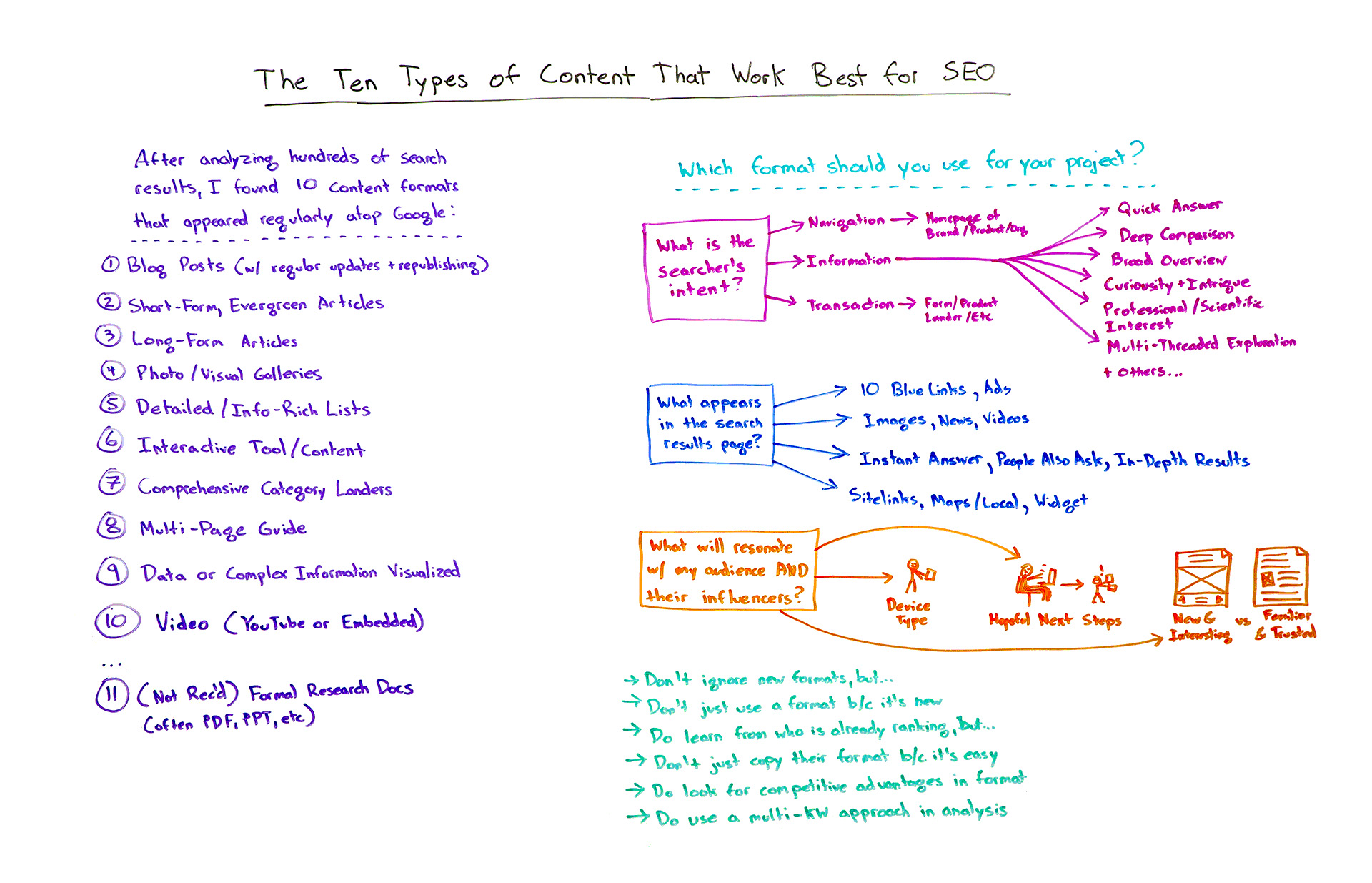
Click on the whiteboard image above to open a high-resolution version in a new tab!
Video Transcription
Howdy, Moz fans, and welcome to another edition of Whiteboard Friday. This week we're going to chat about the types of content, content formats that tend to work well for SEO, and I'm talking specifically about content rather than sort of an e-commerce product page or a contact page or those types of things, and that's because what we want to try and do here is talk about those of you who are doing content strategy and content marketing and choosing which content formats you should potentially use.
So I actually spent a bunch of time over the last few weeks analyzing a few hundred search results, of many, many different kinds, trying to identify the unique, diverse kinds of search results in which content marketing pieces ranked or the types of pieces that would fit into the content marketing world rank.
10 content formats that appeared regularly atop Google
So I made this list of 10. There are actually 11, but I don't particularly recommend all 11 of these, and what I've done is, below the video, you can see in the text content of this Whiteboard Friday I've made a list. For each of these 11, I have a URL that's a good example of this and a search query for which that URL ranks, so you can get a sense of what this type of stuff looks like. So you're probably familiar with most of these formats:
- Blog posts and those could have regular updates or be republished on a regular basise.g. Live & Dare's Benefits of Meditation (ranks for Meditation Benefits)
- Short-form evergreen content and articlese.g. Jim Collin's Piece on Big, Hairy, Audacious Goals (ranks for BHAG)
- Long-form articlese.g. Wait But Why on the Fermi Paradox (ranks for Fermi Paradox)
- Photo and visual galleries, I found a lot of these ranking, especially for things that lent themselves to it, for example if you were to search for men's haircuts styles.e.g. Right Hairstyle's 100 Cool Short Hairstyles for Men/ (ranks for men's hair styles)
- Detailed and information-rich lists of informatione.g. Wareable's Best Fitness Trackers of 2016 (ranks for Fitness Trackers)
- Interactive tools and content, got some good examples of those.e.g. Zoopla's House Prices Tool (ranks for property prices)
- Comprehensive category landers, so this would be like if you search for kitchen designs, how you might land on Houzz's page of various kitchen designs and that's really a lander to get you into more content, so it's not technically a content marketing piece by itself, but it leads you into content pieces or could.e.g. HGTV's Kitchen Ideas (ranks for kitchen remodeling ideas)
- Multi-page guides, things like Moz's Beginner's Guide to SEO, but we have some other examples too.e.g. Bates University's "Painless Guide to Statistics" (ranks for statistics guide)
- Data or complex information that is visualizede.g. CNN's Election Results (ranks for election results 2016)
- Video, YouTube or embedded video on a particular page, Whiteboard Friday itself being an example of that.e.g. Whiteboard Friday itself (ranks for Unique Content)
Then an eleventh format that I don't actually recommend, even though I found it in the search results quite often, and that is the formal research documents that are usually PDFs or Powerpoints or those kinds of things. The reason I don't recommend these formats is because they're actually hard to parse. They're particularly hard to open on mobile devices. They're not very user-friendly, and most of the time the reason they rank well is simply because they're cited by lots of other things. But when you see content marketers invest in one of these spaces and make a document in one of these other formats that's better and more comprehensive and more useful and more user-friendly, they do a much better job and they tend to rank better too.
Which format should you use for your project?
So the question is: Which format should you be using for your project? This is something we have to do at Moz. We ask ourselves this question when we're creating content around SEO and around web marketing information and information of all kinds. So there are sort of three big ones that I ask and then a few tips that I've got for you as well. But first off, I like to start with:
What's the searcher's intent? What are they trying to accomplish?

Now generally speaking, if it's navigation or transaction, content marketing-types of pieces are not the right match for those types of queries. But if it's informational, which is a huge swath, a massive amount of the searches that take place on the web and certainly many of the ones that content marketing is designed to target, because then it can turn those people from, "Yeah, I now know about your brand and I'm now considering you and I thinking about you."
There's a bunch of different variants of these. So things like I'm looking for:
- A quick answer to this question
- A deep comparison of different types of information or different products, different services, different paths that I could choose to answer the action that I'm about to take.
- A broad overview
- I could be searching out something, searching for information purely out of curiosity and intrigue. You know when you go down a rabbit hole around, "Hey, I want to know all the films that Meg Ryan was ever in." Then, "Wait a minute. What is that one? I've never heard of that one, and let me go learn more about that." So the curiosity and intrigue.
- Professional and scientific interests
- Multi-threaded exploration.
Look, there are plenty of others other types of informational queries. The key is to ask yourself which of these are most of the people performing this search query trying to accomplish, and then you can do a better job of narrowing down this list. So you might be able to cut out five or six of these and only leave yourself with a few options after you've answered this question. The next one is:
What actually appears in the search results page?

I mean this two ways. One, who already shows up there, and what kinds of formats are they using?That can be informational. That can give you some inspiration, or it could drive you to want to be different from the rest of them. But also, I'm asking in terms of the SERP features that appear there. Are we talking about:
- 10 blue links and ads, which is very, very classic old school, but uncommon these days? Or are we talking about search verticals appearing in their images, which suggest maybe I should be thinking about...
- Photos or visual galleries or maybe data or complex information visualized, like maybe an informational graphic or more likely a data visualization that's of high quality. I'm not a big infographic fan myself, as you might know from previous Whiteboard Fridays.
- Is it news? In which case, maybe I want a short-form article or a long-form article.
- Is it videos? In which case, I probably want to video.
If we see lots of things like:
- Instant answers, people also ask, in-depth results, that could point us toward the complexity of the information and how much people are willing to go dig into this. So people who also ask suggest that it might be a multi-threaded exploration, a multi-page guide, or a comprehensive category lander could be a good match there. If I see an instant answer, probable that a short-form, evergreen article could do really well, or a blog post that's regularly updated might do well there.
If I see...
- Site links, maps or local, or one of Google or Bing's widgets, that essentially answer the query for you, a search for a calculator or a search for flight prices, they answer that already. A search for weather, they answer that already. Chances are it might be pretty hard to do things in the content marketing world that will actually have success there. I might bias you to look for other things.
Then the third question:
What's going to resonate with two groups — my audience and their influencers?

You need to ask these questions about both those groups. That could mean:
- Device type and where you are searching from. So if somebody is searching on a mobile device and they are on-the-go and this type of query has an intent that is informational but it's very quick information, you might want to consider some of the shorter form stuff.
- If there are hopeful next steps and you know that that's the case, you might want to give something like the multi-page guide or the category lander or the interactive tool or content or that detailed list that gives someone actions they can take right after they've consumed that information.
You also want to consider whether this is a person or this is likely to be a person who is:
- looking for new and interesting formats and they would be fascinated and enjoy exploring that, or whether they're...
- looking for something familiar and trusted, that is not new, that doesn't make them think at all, it just answers their query and gets them finished.
Suggestions
I would say...
- Don't ignore new formats. So if some of these are not things you've considered in the past, don't ignore them.
- Recognize that you shouldn't just use a format because it's new. That is a terrible idea. You should use a format because it works well for your audience, because it serves all of these functions.
- Learn from who's already ranking
- I wouldn't say that you should just copy somebody else's format because it's easy to do and familiar. Make sure that familiar and trusted is the best way that you can compete.
- Look at these content formats and finding ways to get a competitive advantage from them. If all of your competitors are just doing blog posts and short-form and long-form articles, you might be able to win with a visual gallery, you might be able to win with an interactive piece of content or a tool, or you might be able to win with complex information visualized. That's a powerful thing.
- Do use a multi-keyword approach in this analysis. So when I'm saying, "What is the searcher's intent," I'm asking you to consider all of the words and phrases that you're hoping to rank for with this piece of content, not just a single keyword term or phrase. That will give you the best way to choose the right content format for the search queries and the overall goal of attracting the right searchers.
All right everyone, look forward to hearing about some of the formats you've used, maybe some that aren't on this list. If you have great examples of these you'd like to share, we'd certainly love to see them. And we'll see you again next week for another edition of Whiteboard Friday. Take care.
Subscribe to:
Posts (Atom)