New to SEO? Try this beginners tutorial by MOZ ;)

Showing posts with label SEO. Show all posts
Showing posts with label SEO. Show all posts
Saturday, 25 February 2017

Friday, 24 February 2017
Local SEO & Beyond: Ranking Your Local Business in 2017
In 2016, I predicted that ranking in the 3-pack was hard and it would continually get more competitive. I maintain that prediction for 2017, but I want to make one thing clear. If you haven't done so, I believe local businesses should start to look outside of a local-SEO-3-Pack-ONLY focused strategy.

While local SEO still presents a tremendous opportunity to grow your business, I'm going to look at some supplementary organic strategies you can take into your local marketing campaign, as well.
In this post I'm going to address:
- How local search has changed since last year
- Why & how your overall focus may need to change in 2017
- Actionable advice on how to rank better to get more local traffic & more business
In local search success, one thing is clear
The days of getting in the 3-pack and having a one-trick pony strategy are over. Every businesswants to get the free traffic from Google’s local results, but the chances are getting harder everyday. Not only are you fighting against all of your competitors trying to get the same rankings, but now you’re also fighting against even more ads.
If you thought it was hard to get top placement today in the local pack, just consider that you're also fighting against 4+ ads before customers even have the possibility of seeing your business.
Today's SERPs are ad-rich with 4 paid ads at the top, and now it's not uncommon to find paid listings prioritized in local results. Just take a look at this example that Gyi Tsakalakis shared with me, showing one ad in the local pack on mobile ranking above the 3-pack results. Keep in mind, there are four other ads above this.

If you were on desktop and you clicked on one of the 3-pack results, you're taken to the local finder. In the desktop search example below, once you make it to the local finder you'll see two paid local results above the other businesses.
Notice how only the companies participating in paid ads have stars. Do you think that gives them an advantage? I do.

Don't worry though, I'm not jaded by ads
After all of that gloomy ad SERP talk, you're probably getting a little depressed. Don't. With every change there comes new opportunity, and we've seen many of our clients excel in search by focusing on multiple strategies that work for their business.
Focusing on the local pack should still be a strong priority for you, even if you don't have a pay-to-play budget for ads. Getting listed in the local finder can still result in easy wins — especially if you have the most reviews, as Google has very handy sorting options.
If you have the highest rating score, you can easily get clicks when users decide to sort the results they see by the business rating. Below is an example of how users can easily sort by ratings.

But what else can you do to compete effectively in your local market?
Consider altering your local strategy
Most businesses I speak with seem to have tunnel vision. They think it's more important to rank in the local pack and, in some cases, even prioritize this over the real goal: more customers.
Every day, I talk to new businesses and marketers that seem to have a single area of focus. While it's not necessarily a bad thing to do one thing really well, the ones that are most successful are managing a variety of campaigns tied to their business goals.
Instead of taking a single approach of focusing on just free local clicks, expand your horizon a bit and ask yourself this question: Where are my customers looking and how can I get in front of them?
Sometimes taking a step back and looking at things from the 30,000-ft view is beneficial.
You can start by asking yourself these questions by examining the SERPs:
1. What websites, OTHER THAN MY OWN, have the most visibility for the topics and keywords I'm interested in?
You can bet people are clicking on results other than your own website underneath the local results. Are they websites you can show up on? How do you increase that visibility?
I think STAT has a great tracking tool for this. You simply set up the keywords you want to track and their Share of Voice feature shows who's ranking where and what percentage of visibility they have in your specific market.
In the example below, you can see the current leaders in a space I'm tracking. Notice how Findlaw & Yelp show up there. With a little further research I can find out if they have number 1–2 rankings (which they do) and determine whether I should put in place a strategy to rank there. This is called barnacle SEO.

I think STAT has a great tracking tool for this. You simply set up the keywords you want to track and their Share of Voice feature shows who's ranking where and what percentage of visibility they have in your specific market.
In the example below, you can see the current leaders in a space I'm tracking. Notice how Findlaw & Yelp show up there. With a little further research I can find out if they have number 1–2 rankings (which they do) and determine whether I should put in place a strategy to rank there. This is called barnacle SEO.
2. Are my customers using voice search?
Maybe it's just me, but I find it strange to talk to my computer. That being said, I have no reservations about talking to my phone — even when I'm in places I shouldn't. Stone Temple recently published a great study on voice command search, which you can check out here.Some of the cool takeaways from that study were where people search from. It seems people are more likely to search from the privacy of their own home, but most mobile devices out there today have voice search integrated. I wonder how many people are doing this from their cars?
 This goes to show that local queries are not just about the 3-pack. While many people may ask their device "What's the nearest pizza place," other's may ask a variety of questions like:
Where is the highest-rated pizza place nearby?
Who makes the best pizza in Denver?
What's the closest pizza place near me?
Don't ignore voice search when thinking about your localized organic strategy. Voice is mobile and voice can sure be local. What localized searches would someone be interested in when looking for my business? What questions might they be asking that would drive them to my local business?
3. Is my website optimized for "near me" searches?
"Near me" searches have been on the rise over the past five years and I don't expect that to stop. Sometimes customers are just looking for something close by. Google Trends data shows how this has changed in the past five years: Are you optimizing for a "near me" strategy for your business? Recently the guys over at Local SEO Guide did a study of "near me" local SEO ranking factors. Optimizing for "near me" searches is important and it falls right in line with some of the tactical advice we have for increasing your Google My Business rankings as well. More on that later.
4. Should my business stay away from ads?
Let's start by looking at a some facts. Google makes money off of their paid ads. According to an article from Adweek, "During the second quarter of 2016, Alphabet's revenue hit $21.5 billion, a 21% year-over-year increase. Of that revenue, $19.1 billion came from Google's advertising business, up from $16 billion a year ago."This roughly translates to: "Ads aren't going anywhere and Google is going to do whatever they can to put them in your face." If you didn't see the Home Service ad test with all ads that Mike Blumenthal pointed out, you can check it out below. Google is trying to find more creative ways to monetize local search.
 Incase you haven't heard it before, having both organic and paid listings ranking highly increases your overall click-through rate.
Although the last study I found was from Google in 2012, we've found that our clients have the most success when they rank strong organically, locally, and have paid placements. All of these things tie together. If potential customers are already searching for your business, you'll see great results by being involved in all of these areas.
While I'm not a fan of only taking a pay-to-play approach, you need to at least start considering it and testing it for your niche to see if it works for you. Combine it with your overall local and organic strategy.
5. Are we ignoring the featured snippets?
Searches with local intent can still trigger featured snippets. One example that I saw recently and really liked was the snowboard size chart example, which you can see below. In this example, someone who is interested in snowboards gets an answer box that showcases a company. If someone is doing this type of research, there's a likelihood that they may wish to purchase a snowboard soon.
 Depending on your niche, there are plenty of opportunities to increase your local visibility by not ignoring featured snippets and creating content to rank there. Check out this Whiteboard Friday to learn more about how you can get featured snippets.
Depending on your niche, there are plenty of opportunities to increase your local visibility by not ignoring featured snippets and creating content to rank there. Check out this Whiteboard Friday to learn more about how you can get featured snippets.
Now that we've looked at some ways you can expand your strategies, let's look at some tactical steps you can take to move the needle.
Here's how you can gain more visibility
Now that you have an open mind, let's take a look at the actionable things you can do to improve your overall visibility and rankings in locally centric campaigns. As much as I like to think local SEO is rocket science, it really isn't. You really need to focus your attention on the things that are going to move the needle.
I'm also going to assume you've already done the basics, like optimize your listing by filling out the profile 100%.
Later last year, Local SEO Guide and Placescout did a great study that looked at 100+ variables from 30,000 businesses to determine what factors might have the most overall impact in local 3-pack rankings. If you have some spare time I recommend checking it out. It verified that the signals we put the most effort into seem to have the greatest overall effect.
I'm only going to dive into a few of those factors, but here are the things I would do to focus on a results-first strategy:
Start with a solid website/foundation
 What good are rankings without conversions? The answer is they aren't any good. If you're always keeping your business goals in mind, start with the basics. If your website isn't loading fast, you're losing conversions and you may experience a reduced crawl budget.
My #1 recommendation that affects all aspects of SEO and conversions is to start with a solid website. Ignoring this usually creates bigger problems later down the road and can negatively impact your overall rankings.
Your website should be SEO-friendly and load in the 90th percentile on Google's Page Speed Insights. You can also see how fast your website loads for users using tools like GTMetrix. Google seems to reduce the visibility of slower websites, so if you're ignoring the foundation you're going to have issues. Here are 6 tips you can use for a faster Wordpress website.
Your website should be SEO-friendly and load in the 90th percentile on Google's Page Speed Insights. You can also see how fast your website loads for users using tools like GTMetrix. Google seems to reduce the visibility of slower websites, so if you're ignoring the foundation you're going to have issues. Here are 6 tips you can use for a faster Wordpress website.
 Crawl errors for bots can also wreak havoc on your website. You should always strive to maintain a healthy site. Check up on your website using Google's Search Console and use Moz Pro to monitor your clients' campaigns by actively tracking the sites' health, crawl issues, and domain health over time. Having higher scores and less errors should be your focus.
Continue with a strong review generation strategy
 I'm sure many of you took a deep breath when earlier this month Google changed the review threshold to only 1 review. That's right. In case you didn't hear, Google is now giving all businesses a review score based on any number of reviews you have, as you can see in the example below:
  I know a lot of my colleagues were a big fan of this, but I have mixed feelings since Google isn't taking any serious measures to reduce review spam or penalize manipulative businesses at this point.
Don't ignore the other benefits of reviews, as well. Earlier I mentioned that users can sort by review stars; having more reviews will increase your overall CTR. Plus, after talking to many local businesses, we've gotten a lot of feedback that consumers are actively using these scores more than ever.
So, how do you get more reviews?
Luckily, Google's current Review and Photo Policies do not prohibit the direct solicitation of reviews at this point (unlike Yelp).
Start by soliciting past customers on your list
If you're not already collecting customer information on your website or in-store, you're behind the times and you need to start doing so immediately.
If you're not already collecting customer information on your website or in-store, you're behind the times and you need to start doing so immediately.
I work mainly with attorneys. Working in that space, there are regulations we have to follow, and typically the number of clients is substantially less than a pizza joint. In pickles like this, where the volume is low, we can take a manual approach where we identify the happiest clients and reach out to them using this process. This particular process also creates happy employees. :)
- List creation: We start by screening the happiest clients. We then sort these by who has a Gmail account for priority's sake.
- Outreach by phone: I don't know why digital marketers are afraid of the phone, but we've had a lot of success calling our prior clients. We have the main point-of-contact from the business who's worked with them before call and ask how the service they received was. The caller informs them that they have a favor to ask and that their overall job performance is partially based off of client feedback. They indicate they're going to send a follow-up email if it's OK with the customer.
- Send a follow-up email: We then use a Google review link generator, which creates an exact URL that opens the review box for the person if they're logged into their Gmail account.
- Follow-up email: Sometimes emails get lost. We follow up a few times to make sure the client leaves the review...
- You have a new review!
The method above works great for low-volume businesses. If you're a higher-volume business or have a lot of contacts, I recommend using a more automated service to prepare for future and ongoing reviews, as it'll make the process a heck of a lot easier. Typically we use Get Five Stars or Infusionsoft integrations to complete this for our clients.
If you run a good business that people like, you can see results like this. This is a local business which had 7 reviews in 2015. Look where they are now with a little automation asking happy customers to leave a review:

Don't ignore & don't be afraid of links

One thing Google succeeded at is scaring away people from getting manipulative links. In many areas, that went too far and resulted in people not going after links at all, diminishing their value as a ranking factor, and telling the world that links are dead.
Well, I'm here to tell you that you need good links to your website. If you want to rank in competitive niches or in certain geographic areas, the anchor text can make a big difference. Multiple studies have shown the effectiveness of links to this very day, and their importance cannot be overlooked.
Well, I'm here to tell you that you need good links to your website. If you want to rank in competitive niches or in certain geographic areas, the anchor text can make a big difference. Multiple studies have shown the effectiveness of links to this very day, and their importance cannot be overlooked.
This table outlines which link tactics work best for each strategy:
| Strategy Type | Link Tactic |
|---|---|
| Local SEO (3-Pack) | Links to local GMB-connected landing page will help 3-pack rankings. City, state, and keyword-included anchor text is beneficial |
| Featured Snippets | Links to pages where you want to get a featured snippet will help boost the authority of that page. |
| Paid Ads | Links will not help your paid ads. |
| "Near Me" Searches | Links with city, state, or area anchor text will help you in near me searches. |
| Voice Search | Links to pages that are FAQ or consist of long-tail keyword content will help them rank better organically. |
| Barnacle SEO | Links to websites you don't own can help them rank better. Focus on high-authority profiles or business listings. |
There are hundreds of ways to build links for your firm. You need to avoid paying for links and spammy tactics because they're just going to hurt you. Focus on strong and sustainable strategies — if you want to do it right, there aren't any shortcuts.
Since there are so many great link building resources out there, I've linked to a few of my favorite where you can get tactical advice and start building links below.
For specific tactical link building strategies, check out these resources:
- Link Building Tactics by Jon Cooper - This is the most comprehensive list I have found.
- Link Building: The Definitive Guide from Backlinko
- 21 Link Building Tips from Juris Digital
- The Ultimate List of Local Link Building Ideas from Nifty Marketing
If you participate in outreach or broken link building, check out this new post from Directive Consulting — "How We Increased Our Email Response Rate from ~8% to 34%" — to increase the effectiveness of your outreach.
Get relevant & high-authority citations
 While the importance of citations has taken a dive in recent years as a major ranking factor, they still carry quite a bit of importance.
Do you remember the example from earlier in this post, where we saw Findlaw and Yelp having strong visibility in the market? These websites get traffic, and if a potential customer is looking for you somewhere where you're not, that's one touchpoint lost. You'll still need to address quality over quantity. The days of looking for 1,000 citations are over and have been for many years. If you have 1,000 citations, you probably have a lot of spam links to your website. We don't need those. But what we do need is highly relevant directories to either our city or niche.
This post I wrote over 4 years ago is still pretty relevant on how you can find these citations and build them with consistency. Remember that high-authority citations can also be unstructured (not a typical business directory). They can also be very high-quality links if the site is authoritative and has fewer business listings. There are millions of listings on Yelp, but maybe less than one hundred on some other powerful, very niche-specific websites.
Citation and link idea: What awards was your business eligible or nominated for?
One way to get these is to consider awards where you can get an authoritative citation and link to your website. Take a look at the example below of a legal website. This site is a peanut compared to a directory like Yelp. Sure, it doesn't carry near as much authority, but the link equity is more evenly distributed.

This post I wrote over 4 years ago is still pretty relevant on how you can find these citations and build them with consistency. Remember that high-authority citations can also be unstructured (not a typical business directory). They can also be very high-quality links if the site is authoritative and has fewer business listings. There are millions of listings on Yelp, but maybe less than one hundred on some other powerful, very niche-specific websites.
Citation and link idea: What awards was your business eligible or nominated for?
One way to get these is to consider awards where you can get an authoritative citation and link to your website. Take a look at the example below of a legal website. This site is a peanut compared to a directory like Yelp. Sure, it doesn't carry near as much authority, but the link equity is more evenly distributed.
Lastly, stay on point
2017 is sure to be a volatile year for local search, but it's important to stay on point. Spread your wings, open your mind, and diversify with strategies that are going to get your business more customers.
Now it's time to tell me what you think! Is something I didn't mention working better for you? Where are you focusing your efforts in local search?
Monday, 20 February 2017
How to Prioritize Your Link Building Efforts & Opportunities
We all know how effective link building efforts can be, but it can be an intimidating, frustrating process — and sometimes even a chore. In today's Whiteboard Friday, Rand builds out a framework you can start using today to streamline and simplify the link building process for you, your teammates, and yes, even your interns.

Click on the whiteboard image above to open a high-resolution version in a new tab!
Video Transcription
Howdy, Moz fans, and welcome to another edition of Whiteboard Friday. As you can see, I'm missing my moustache, but never mind. We've got tons of important things to get through, and so we'll leave the facial hair to the inevitable comments.
I want to talk today about how to prioritize your link building efforts and opportunities. I think this comes as a big challenge for many marketers and SEOs because link building can just seem so daunting. So it's tough to know how to get started, and then it's tough to know once you've gotten into the practice of link building, how do you build up a consistent, useful system to do it? That's what I want to walk you through today.
Step 1: Tie your goals to the link's potential value
So first off, step one. What I'm going to ask you to do is tie your SEO goals to the reasons that you're building links. So you have some reason that you want links. It is almost certainly to accomplish one of these five things. There might be other things on the list too, but it's almost always one of these areas.
- A) Rank higher for keyword X. You're trying to get links that point to a particular page on your site, that contain a particular anchor text, so that you can rank better for that. Makes total sense. There we go.
- B) You want to grow the ranking authority of a particular domain, your website, or maybe a subdomain on your website, or a subfolder of that website. Google does sort of have some separate considerations for different folders and subdomains. So you might be trying to earn links to those different sections to help grow those. Pretty similar to (A), but not necessarily as much of a need to get the direct link to the exact URL.
- C) Sending real high-value traffic from the ranking page. So maybe it's the case that this link you're going after is no followed or it doesn't pass ranking influence, for some reason — it's JavaScript or it's an advertising link or whatever it is — but it does pass real visitors who may buy from you, or amplify you, or be helpful to achieving your other business goals.
- D) Growing topical authority. So this is essentially saying, "Hey, around this subject area or keyword area, I know that my website needs some more authority. I'm not very influential in this space yet, at least not from Google's perspective. If I can get some of these links, I can help to prove to Google and, potentially, to some of these visitors, as well, that I have some subject matter authority in this space."
- E) I want to get some visibility to an amplification-likely or a high-value audience. So this would be things like a lot of social media sites, a lot of submission type sites, places like a Product Hunt or a Reddit, where you're trying to get in front of an audience, that then might come to your site and be likely to amplify it if they love what they see.
Okay. So these are our goals.
Step 2: Estimate the likelihood that the link target will influence that goal

Second, I'm going to ask you to estimate the likelihood that the link target will pass value to the page or to the section of your site. This relies on a bunch of different judgments.
You can choose whether you want to wrap these all up in sort of a single number that you estimate, maybe like a 0 to 10, where 0 is not at all valuable, and 10 is super, super valuable. Or you could even take a bunch of these metrics and actually use them directly, so things like domain authority, or linking root domains to the URL, or page authority, the content relevance.
You could be asking:
- Is this a nofollowed or a followed link?
- Is it passing the anchor text that I'm looking for or anchor text that I control or influence at all?
- Is it going to send me direct traffic?
If the answers to these are all positive, that's going to bump that up, and you might say, "Wow, this is high authority. It's passing great anchor text. It's sending me good traffic. It's a followed link. The relevance is high. I'm going to give this a 10."
Or that might not be the case. This might be low authority. Maybe it is followed, but the relevance is not quite there. You don't control the anchor text, and so anchor text is just the name of your brand, or it just says "site" or something like that. It's not going to send much traffic. Maybe that's more like a three.
Then you're going to ask a couple of questions about the page that they're linking to or your website.
- Is that the right page on your site? If so, that's going to bump up this number. If it's not, it might bring it down a little bit.
- Does it have high relevance? If not, you may need to make some modifications or change the link path.
- Is there any link risk around this? So if this is a — let's put it delicately — potentially valuable, but also potentially risky page, you might want to reduce the value in there.
I'll leave it up to you to determine how much link risk you're willing to take in your link building profile. Personally, I'm willing to accept none at all.
Step 3: Build a prioritization spreadsheet

Then step three, you build a prioritization spreadsheet that looks something like this. So you have which goal or goals are being accomplished by acquiring this link. You have the target and the page on your site. You've got your chance of earning that link. That's going to be something you estimate, and over time you'll get better and better at this estimation. Same with the value. We talked about using a number out of 10 over here. You can do that in this column, or you could just take a bunch of these metrics and shove them all into the spreadsheet if you prefer.
Then you have the tactic you're going to pursue. So this is direct outreach, this one's submit and hope that it does well, and who it's assigned to. Maybe it's only you because you're the only link builder, or maybe you have a number of people in your organization, or PR people who are going to do outreach, or someone, a founder or an executive who has a connection to some of these folks, and they're going to do the outreach, whatever the case.
Then you can start to prioritize. You can build that prioritization by doing one of a couple things. You could take some amalgamation of these numbers, so like a high chance of earning and a high estimated value. We'll do some simple multiplication, and we'll make that our prioritization. Or you might give different goals. Like you might say, "Hey, you know what? (A) is worth a lot more to me right now than (C). So, therefore, I'm going to rank the ones that are the (A) goal much higher up." That is a fine way to go about this as well. Then you can sort your spreadsheet in this fashion and go down the list. Start at the top, work your way down, and start checking off links as you get them or don't get them. That's a pretty high percentage, I'm doing real well here. But you get the idea.
This turns link building from this sort of questionable, frustrating, what should I do next, am I following the right path, into a simple process that not only can you follow, but you can train other people to follow. This is really important, because link building is an essential part of SEO, still a very valuable part of SEO, but it's also a slog. So, to the degree that you can leverage other help in your organization, hire an intern and help train them up, work with your PR teams and have them understand it, have multiple people in the organization all sharing this spreadsheet, all understanding what needs to be done next, that is a huge help.
I look forward to hearing about your link building prioritization, goals, what you've seen work well, what metrics you've used. Let us know in the comments :)
Monday, 13 February 2017
How To Perform A Better Keyword Research [infographic]

A better search engine optimization always starts with strong keyword research. Because it is important to know the way users are searching the content, it is quite difficult to ensure that your blog presents to them using the words people looking for. So to help you out, Promodo has created this infographic that illustrates the major and important factors of the keyword research process.
Click image to enlarge+.
![How To Perform A Better Keyword Research [infographic]](https://s-media-cache-ak0.pinimg.com/originals/c8/08/13/c80813fb9bef8ee848d959c557e4ae07.png)
Thursday, 2 February 2017
Do organic keyword rankings matter anymore?

With all the ways search engine results pages have evolved over the years, columnist Julian Connors explores the question of whether SEO is still a wise investment.
High keyword rankings are the most sought-after achievement in the world of search engine optimization (SEO). Small businesses and brands alike strive to obtain the first organic listing in search results because of the lucrative traffic and lead opportunities that are associated with this position.
But with the evolution of paid advertising and expansion of universal search, as well as Google’s continuous efforts to provide consumers with content that resolves their demands directly in search results, the opportunities attached to traditional keyword rankings are diminishing at an alarming rate.
In today’s search landscape, SEOs and digital marketing specialists have to consider whether it’s worth the amount of time and resources it takes to achieve premier organic rankings, considering the click-through rates (CTR) associated with organic rankings that are positioned under PLAs, local results and other forms of content.
Keyword rankings aren’t the only way to connect to online customers
There was a time not too long ago when achieving the first organic position on Google was one of the only ways to attract new online customers to a website without having to invest in paid advertising or e-mail marketing.
Ten years ago, the world was just warming up to the power of social media and its influence on the World Wide Web. Back then, most consumers were just starting to become aware of YouTube’s marketing power, Facebook was starting to open itself up to audiences outside of college students, and blogging was just starting to become mainstream, as everyone from CNN to Mashable began investing in new, niche content in the form of top lists and how-to articles.
Because of this boom in social connectivity, businesses and brands suddenly had access to free channels that were viable for attracting new business to their websites.
In 2017, there are thousands of social media platforms to join, millions of user-generated content forums, and approximately 320 million blogs around the world (up from 260 million in 2015).
Today, it’s rare to find a local business or brand that isn’t connected to an established directory host like Yelp or TripAdvisor, whose own online credibility is so impressive that it allows their less authoritative clients to rank well within organic results.
New niche environments allow businesses to focus on conversions, not site traffic
When companies and brands were only able to connect with new customers through organic rankings, it made sense to invest a significant amount of time and resources to build thousands of links and cram keywords into a particular website to increase visibility.
Now that there are thousands of free channels that cater to niche demographics with specific interests, it’s easier than ever for brands to identify relevant environments that can be targeted for conversions. The online landscape of today allows businesses and brands to focus on maximizing qualified conversions, rather than trying to gain as much traffic as possible with the hopes that a particular portion is going to convert into a sale.
One of the problems with keyword rankings is that any consumer can click through to a website and immediately leave because the title tag and meta description didn’t align with the content of its associated landing page. Ranking first on Google does not mean that every visitor is going to turn into a paying customer because of how limited keywords are for understanding granular details associated with online consumers.
Social media and other niche online communities trump the value of keyword rankings because they serve as natural environments for like-minded users with specific interests to hang out in, consuming new forms of hyper-focused content that keep them returning.
Because of how easy it is today for businesses to build strong social media followings, basic engagement can improve everything from brand awareness and online reputation to traffic and revenue. Keyword rankings lack the power of social media because they are not proactive means of engagement, and they don’t necessarily connect brands with the type of qualified traffic that exists and is readily available in communities like Reddit or Instagram.
Google is crushing the desire to achieve premier keyword rankings
It’s always important to keep in mind that Google is a business; they are not just a convenient means for finding information or purchasing products.
Recognizing that Google is a business that competes in a free market where consumers have options, it is their goal to become an all-inclusive destination that provides an experience that is so fulfilling, it keeps consumers returning to their search engine.
Local results bury traditional rankings
Google’s focus on providing content that displays local options for consumers to consider has diminished the power of premier keyword rankings for some industries which were appearing at the very top of search listings, only to now be buried beneath the fold.
Sponsored ads blend with organic results
Product listing ads and the inclusion of a fourth paid search ad for certain highly commercial queries have pushed organic results down the page even further, which significantly reduces the CTR of each organic position.
Considering that the first organic position on Google commanded a 31 percent CTR in 2014 and the fourth position garnered a 7 percent CTR, it’s clear that today’s blended search results pages may render top organic results that are not nearly as powerful for driving site traffic as they used to be.
Free products, direct answers & featured snippets diminish consumers’ need to engage in site content
The ability for Google to resolve consumer demands without having to enter a particular website continues to increase, as there are more free products, definitions and featured snippets appearing every day.
Informational websites that depend on attracting a tremendous amount of traffic in order to maintain their ad rates are at the mercy of featured snippets, which provide users with immediate answers whenever they search with specific questions. Featured snippets also push traditional rankings below the fold, which may negatively affect CTR.
Why keyword rankings are still important for success
Although all of the points made against the effort it takes to build premier keyword rankings are valid, it is still important for businesses and brands to actively strive for premier organic rankings.
Despite diminished visibility and CTR within particular types of search listings, organic rankings remain one of the most powerful entrances for brands to connect with new customers.
SEOs and digital marketing specialists can maximize their traffic and conversion opportunities through keyword rankings by creating quality content around niche concepts and phrases that their target audience uses or searches for. This allows brands to increase their monthly traffic and receive qualified conversions based on the type of consumer research that guides their content development efforts.
Like anything else with digital marketing, the formula for achieving success is to maintain a campaign that combines social media, paid advertising, SEO and other relevant channels.
Some opinions expressed in this article may be those of a guest author and not necessarily Search Engine Land. Staff authors are listed here.
Wednesday, 21 December 2016
The 10 Types of Content That Work Best for SEO
After analyzing hundreds of SERPs over the past few weeks, Rand has identified the 10 distinct content types that work best for SEO and classified which formats are suited for certain queries. In today's Whiteboard Friday, he explains those content types and how to use them to satisfy searcher intent, match them to the right projects, and enhance your overall strategy.
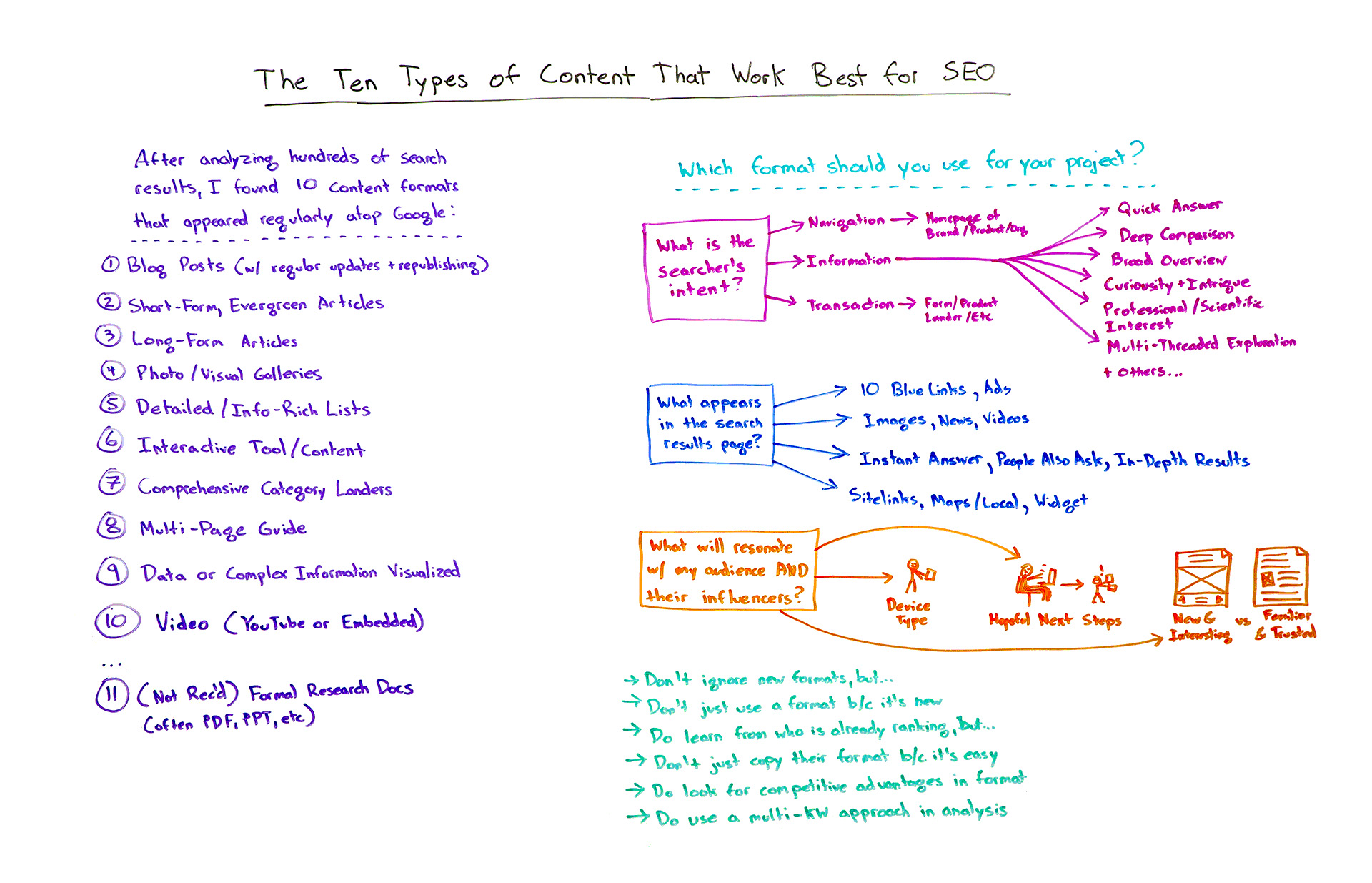
Click on the whiteboard image above to open a high-resolution version in a new tab!
Video Transcription
Howdy, Moz fans, and welcome to another edition of Whiteboard Friday. This week we're going to chat about the types of content, content formats that tend to work well for SEO, and I'm talking specifically about content rather than sort of an e-commerce product page or a contact page or those types of things, and that's because what we want to try and do here is talk about those of you who are doing content strategy and content marketing and choosing which content formats you should potentially use.
So I actually spent a bunch of time over the last few weeks analyzing a few hundred search results, of many, many different kinds, trying to identify the unique, diverse kinds of search results in which content marketing pieces ranked or the types of pieces that would fit into the content marketing world rank.
10 content formats that appeared regularly atop Google
So I made this list of 10. There are actually 11, but I don't particularly recommend all 11 of these, and what I've done is, below the video, you can see in the text content of this Whiteboard Friday I've made a list. For each of these 11, I have a URL that's a good example of this and a search query for which that URL ranks, so you can get a sense of what this type of stuff looks like. So you're probably familiar with most of these formats:
- Blog posts and those could have regular updates or be republished on a regular basise.g. Live & Dare's Benefits of Meditation (ranks for Meditation Benefits)
- Short-form evergreen content and articlese.g. Jim Collin's Piece on Big, Hairy, Audacious Goals (ranks for BHAG)
- Long-form articlese.g. Wait But Why on the Fermi Paradox (ranks for Fermi Paradox)
- Photo and visual galleries, I found a lot of these ranking, especially for things that lent themselves to it, for example if you were to search for men's haircuts styles.e.g. Right Hairstyle's 100 Cool Short Hairstyles for Men/ (ranks for men's hair styles)
- Detailed and information-rich lists of informatione.g. Wareable's Best Fitness Trackers of 2016 (ranks for Fitness Trackers)
- Interactive tools and content, got some good examples of those.e.g. Zoopla's House Prices Tool (ranks for property prices)
- Comprehensive category landers, so this would be like if you search for kitchen designs, how you might land on Houzz's page of various kitchen designs and that's really a lander to get you into more content, so it's not technically a content marketing piece by itself, but it leads you into content pieces or could.e.g. HGTV's Kitchen Ideas (ranks for kitchen remodeling ideas)
- Multi-page guides, things like Moz's Beginner's Guide to SEO, but we have some other examples too.e.g. Bates University's "Painless Guide to Statistics" (ranks for statistics guide)
- Data or complex information that is visualizede.g. CNN's Election Results (ranks for election results 2016)
- Video, YouTube or embedded video on a particular page, Whiteboard Friday itself being an example of that.e.g. Whiteboard Friday itself (ranks for Unique Content)
Then an eleventh format that I don't actually recommend, even though I found it in the search results quite often, and that is the formal research documents that are usually PDFs or Powerpoints or those kinds of things. The reason I don't recommend these formats is because they're actually hard to parse. They're particularly hard to open on mobile devices. They're not very user-friendly, and most of the time the reason they rank well is simply because they're cited by lots of other things. But when you see content marketers invest in one of these spaces and make a document in one of these other formats that's better and more comprehensive and more useful and more user-friendly, they do a much better job and they tend to rank better too.
Which format should you use for your project?
So the question is: Which format should you be using for your project? This is something we have to do at Moz. We ask ourselves this question when we're creating content around SEO and around web marketing information and information of all kinds. So there are sort of three big ones that I ask and then a few tips that I've got for you as well. But first off, I like to start with:
What's the searcher's intent? What are they trying to accomplish?

Now generally speaking, if it's navigation or transaction, content marketing-types of pieces are not the right match for those types of queries. But if it's informational, which is a huge swath, a massive amount of the searches that take place on the web and certainly many of the ones that content marketing is designed to target, because then it can turn those people from, "Yeah, I now know about your brand and I'm now considering you and I thinking about you."
There's a bunch of different variants of these. So things like I'm looking for:
- A quick answer to this question
- A deep comparison of different types of information or different products, different services, different paths that I could choose to answer the action that I'm about to take.
- A broad overview
- I could be searching out something, searching for information purely out of curiosity and intrigue. You know when you go down a rabbit hole around, "Hey, I want to know all the films that Meg Ryan was ever in." Then, "Wait a minute. What is that one? I've never heard of that one, and let me go learn more about that." So the curiosity and intrigue.
- Professional and scientific interests
- Multi-threaded exploration.
Look, there are plenty of others other types of informational queries. The key is to ask yourself which of these are most of the people performing this search query trying to accomplish, and then you can do a better job of narrowing down this list. So you might be able to cut out five or six of these and only leave yourself with a few options after you've answered this question. The next one is:
What actually appears in the search results page?

I mean this two ways. One, who already shows up there, and what kinds of formats are they using?That can be informational. That can give you some inspiration, or it could drive you to want to be different from the rest of them. But also, I'm asking in terms of the SERP features that appear there. Are we talking about:
- 10 blue links and ads, which is very, very classic old school, but uncommon these days? Or are we talking about search verticals appearing in their images, which suggest maybe I should be thinking about...
- Photos or visual galleries or maybe data or complex information visualized, like maybe an informational graphic or more likely a data visualization that's of high quality. I'm not a big infographic fan myself, as you might know from previous Whiteboard Fridays.
- Is it news? In which case, maybe I want a short-form article or a long-form article.
- Is it videos? In which case, I probably want to video.
If we see lots of things like:
- Instant answers, people also ask, in-depth results, that could point us toward the complexity of the information and how much people are willing to go dig into this. So people who also ask suggest that it might be a multi-threaded exploration, a multi-page guide, or a comprehensive category lander could be a good match there. If I see an instant answer, probable that a short-form, evergreen article could do really well, or a blog post that's regularly updated might do well there.
If I see...
- Site links, maps or local, or one of Google or Bing's widgets, that essentially answer the query for you, a search for a calculator or a search for flight prices, they answer that already. A search for weather, they answer that already. Chances are it might be pretty hard to do things in the content marketing world that will actually have success there. I might bias you to look for other things.
Then the third question:
What's going to resonate with two groups — my audience and their influencers?

You need to ask these questions about both those groups. That could mean:
- Device type and where you are searching from. So if somebody is searching on a mobile device and they are on-the-go and this type of query has an intent that is informational but it's very quick information, you might want to consider some of the shorter form stuff.
- If there are hopeful next steps and you know that that's the case, you might want to give something like the multi-page guide or the category lander or the interactive tool or content or that detailed list that gives someone actions they can take right after they've consumed that information.
You also want to consider whether this is a person or this is likely to be a person who is:
- looking for new and interesting formats and they would be fascinated and enjoy exploring that, or whether they're...
- looking for something familiar and trusted, that is not new, that doesn't make them think at all, it just answers their query and gets them finished.
Suggestions
I would say...
- Don't ignore new formats. So if some of these are not things you've considered in the past, don't ignore them.
- Recognize that you shouldn't just use a format because it's new. That is a terrible idea. You should use a format because it works well for your audience, because it serves all of these functions.
- Learn from who's already ranking
- I wouldn't say that you should just copy somebody else's format because it's easy to do and familiar. Make sure that familiar and trusted is the best way that you can compete.
- Look at these content formats and finding ways to get a competitive advantage from them. If all of your competitors are just doing blog posts and short-form and long-form articles, you might be able to win with a visual gallery, you might be able to win with an interactive piece of content or a tool, or you might be able to win with complex information visualized. That's a powerful thing.
- Do use a multi-keyword approach in this analysis. So when I'm saying, "What is the searcher's intent," I'm asking you to consider all of the words and phrases that you're hoping to rank for with this piece of content, not just a single keyword term or phrase. That will give you the best way to choose the right content format for the search queries and the overall goal of attracting the right searchers.
All right everyone, look forward to hearing about some of the formats you've used, maybe some that aren't on this list. If you have great examples of these you'd like to share, we'd certainly love to see them. And we'll see you again next week for another edition of Whiteboard Friday. Take care.
Subscribe to:
Posts (Atom)