Showing posts with label marketing strategy. Show all posts

Thursday, 26 January 2017

Secret Strategy Ingredients to a Successful Branding

The Secret Ingredients to a Successful Branding Strategy

Do you need your business to thrive? Then apart from a great product, harness the power of branding. Branding is not just for the big companies with bigger budgets. You want to thrive amongst cut throat competition, right? Then even the small businesses need to embrace branding.

Common Ingredients of Successful Brands

Before you know the secret strategies to successful branding, let us talk about the common features of branding first. Check if you have these ingredients incorporated into your existing branding strategy. 

Know Your Audience

This ingredient is true regardless of your business or profession. Once you know your audience it can help you set the tone for all your communication to that audience. Get your audience to relate to your content and your message. Then the creation of this organic connection is valuable for your business and services.

Unique Selling Proposition

Every successful brand has something unique about them that makes them stick out of the crowd. Think what helps people differentiate between McDonald's or Wendy’s. They both sell burgers and fries, right? But they both have their unique selling propositions.

Passion for Product/Service

Think about Apple when it had Steve Jobs calling the shots? His passion for technology permeated through his products. After his passing, Apple may have lost its simplicity.

Consistency in Product/Service

When a business or a service is consistent, customers appreciate that. It gets the business repeat sales and loyal customers. This is enviable, considering the volume of competition most businesses face now is high.

Secret Ingredients to a Successful Branding

You want your business to stick out of the crowd and not forgotten. You need smarter strategies to make your branding successful. Here are some not-so-talked-about ingredients to successful branding:

Create the Need like Apple, Airbnb

Ever wondered why Apple products were so successful? You cannot deny how the iPod or the iPhones were so ahead of their time. The iPhone practically paved the way for smartphones. Apple’s advertising slogan “Think Different” in 1997 made a big impact. A product was here that people didn't even think they needed. 

What is common between Apple and Airbnb? They both created a need for its consumers. The 2016 Olympics in Rio was a testament to the revolutionary idea of renting homes. Airbnb paved the way for alternate accommodations for travelers on a budget. So, what can you do to position your product or service to your target audience?

Quality Over Quantity like Pixar

Some of the best-animated movies are by Pixar Computer Animation Company. When you know the movie has a Pixar banner, you can almost guarantee it will worth your time and money. Why? Because they put quality over quantity in their product. Pixar is known to put in at least 5 years into each movie. Now that is a rung higher than passion. It is a commitment to excellence. So, what is your brand known for? 
  

Cover Everything like GE

A successful branding strategy is more than just a cool logo or a tagline. The best kind of branding ensures that the brand has value, economic value! Brands get more business because of their intangible value. For instance, Apple is valued at $98.3 billion. So, if you want to get more value for your brand, consider venturing like GE. They are everywhere: from medical equipment to oil and gas. That way, if one business fails, GE’s strong brand value keeps them standing firm.

Target Specific Demographic like BMW

We discussed how important knowing your target audience was. Now the secret to successful branding knows how to use that information. Then position your product or service to that audience. BMW does that brilliantly. It designs its cars with robust interiors and exteriors. It matches to their target audience who is high income, either a bachelor or newlywed, usually a professional or executive.

Positive Spin to Bad PR like Chipotle

When there is a scandal or a conflict to your brand, don't get under the pressure. Get over it gracefully as Chipotle did. There was a scandal about e-coli spreading through Chipotle products. But the brand has decided to push back with positive brand messages. They are all about food safety standards, using high-quality ingredients, etc. It is a great reminder of everything that the brand stands for in the first place. 

Find Your Digital Voice like GE

Who would've thought an industrial company that covers everything from aircraft engines, power generation and oil and gas production equipment to medical imaging, financing and industrial products is the best social media brand today? The way they convey what they do through their visual imagery is fantastic. Their content gets people interested in what they do. General Electric (GE) creates that curiosity about science and technology through social media. Do your marketing efforts help increase your brand value this way? 

Bonus infographic:

The Power of Branding

The Power of Branding [Infographic]

Infographic Source: Missdetails / Featured image: shutterstock.


Monday, 12 December 2016

Content Shock: Why content marketing is not a sustainable strategy

content shock
By Mark Schaefer
This post will demonstrate in simple economic terms why content marketing — the hottest marketing trend around — may not be a sustainable strategy for many businesses.
Like any good discussion on economics, this is rooted in the very simple concept of supply and demand. When supply exceeds demand, prices fall. But in the world of content marketing, the prices cannot fall because the “price” of the content is already zero — we give it away for free. So, to get people to consume our content, we actually have to pay them to do it, and as the supply of content explodes, we will have to pay our customers increasing amounts to the point where it is not feasible any more.
Paying people to read our content? Does that sound crazy? But you’re already doing it. Let me explain.

You are “paying” people to read your content

When I got my very first company laptop computer (a brick-like device called a GRID) I eagerly plugged it into the phone line and took my first step on to the Internet with that unforgettable AOL screech-and-hiss of a connection sound.
I explored the meager content offerings and found a file with NASA photographs. I clicked on a link and over a period of 10 minutes, a photograph began to download onto my screen.
This was a tremendously exciting breakthrough and I called out to my wife and children “Quick! Come see this! I’m getting a photograph right through the telephone line!”
At that time, the seemingly miraculous ability to access a piece of content — any content at all — was a thrill. We were starved for content and stared with wonder at literally anything we could obtain through this new electronic conduit.
Fast forward to 2009, the year I became a serious content creator. At that point, the web was still a relatively uncrowded “content space.”  Red Bull was a beverage company, not a media company, Chipotle was making burritos, not clay-mation films, and there were roughly one-third as many bloggers as there are now … not to mention podcast producers, video-makers, Pinterest pinners, Facebook posters, and Instagram photographers.
Let’s say that in 2009 I spent five hours a week creating content that would be consumed by my blog readers. This was a happy time because not only was the content competition weak, consumption was dramatically increasing too — more people were piling on to the web, on to social media, and on to mobile devices that extended the amount of time each day they could consume content.
For argument’s sake, let’s value my time at $100 per hour. So with 5 hours of content creation in 2009, I was “paying” my readers $500 in my time to consume my content each week. The value I was receiving in return from new business connections far exceeded that investment, so this made good economic sense.

The content model falls apart

Let’s fast forward one more time to 2014 and look at the two factors that impact the economics of content marketing — the amount of content available and the amount of content consumed (supply and demand).
Of course the volume of free content is exploding at a ridiculous rate. Depending on what study you read, the amount of available web-based content (the supply) is doubling every 9 to 24 months. Unimaginable, really.
However, our ability to consume that content (the demand) is finite. There are only so many hours in a day and even if we consume content while we eat, work and drive, there is a theoretical and inviolable limit to consumption, which we are now approaching.
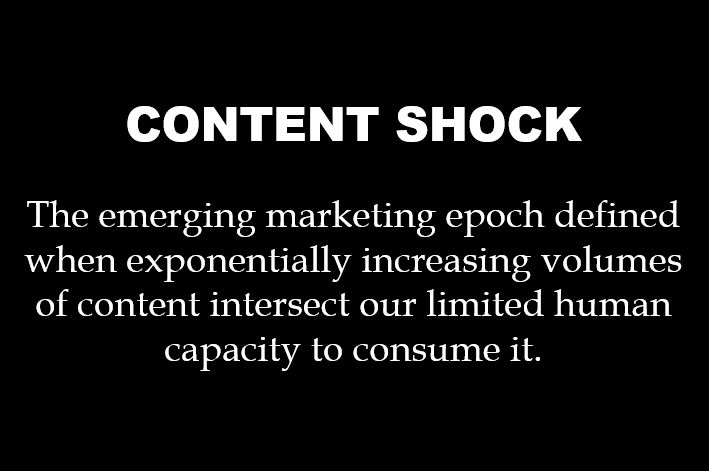
This intersection of finite content consumption and rising content availability will create a tremor I call The Content Shock. In a situation where content supply is exponentially exploding while content demand is flat, we would predict that individuals, companies, and brands would have to “pay” consumers more and more just to get them to see the same amount of content.
And that is exactly what is happening.
Content Shock definition
I know that you are under a barrage of distractions from increasingly amazing content. For me to simply maintain the “mindshare” I have with you today on this blog, I am going to have to create significantly better content, which of course will take significantly more time. I will probably have to pay Facebook and others to give you a chance to even see it because of this content competition for attention.
I will have to “pay” you at much higher rates just to keep the same number of readers in 2015 that I had in 2014.
Let’s look at this in graphical terms:
content shock
According to Nielsen and other sources, the amount of content we consume on a daily basis has grown from two hours a day in the 1920s to nearly 11 hours per day today. Propelled by mobile devices, the average amount of content we consume on a daily basis has gone up by two hours a day just in the last three years!
How much higher can this go? 12 hours a day? 13? Who knows. But there is some limit.
On the supply side of the equation, the amount of information on the web is expected to increase by 500 percent (conservatively) in the next five years. If you can imagine how big the Internet is, in the next five years, we are going to have five of those.
Do you think it is going to be a little more difficult to be successful in content marketing?

Content Shock is here

This upward trend of content consumption is not sustainable because every human has a physiological, inviolable limit to the amount of content they can consume. I believe as marketers, we have been lulled into a false sense of security thinking that this consumption trend will continue to rise without end. That is simply not possible. The Content Shock is coming and I believe we are beginning to enter the danger zone now.
Every single content producer, every marketer, and every business is standing at this same cliff to some degree, and the implications are vast.

1) Deep pockets win

First, as each new media channel has emerged, it is originally fueled with crude “local” content but the eventual winners are the content creators with the deepest pockets. When television started, for example, the airwaves were filled with local programming (kind of like the bloggers of their day!) who created cooking shows, game shows and variety shows using local talent. Today, there is virtually no “local” content consumed on TV, as the corporations have taken over.
If you examined a list of the most popular YouTube videos five years ago, they were “locally-produced” home movies. Today the most popular videos are dominated by big names and big brands producing slickly-produced films and music videos.
Over time, the low budget content producers are eased out of the consumer mindshare as we “pay” more for their attention.
The idea that “great content rises to the top” is over. We are in an era where advertising, promotion, and distribution strategies may eclipse the importance of the content itself.

2) The entry barriers become impossibly high

We see the deep pockets trend occurring in even the smallest market niches. The companies that can overwhelm the market with content can effectively raise the entry hurdles for competitors and maybe even block them out of key search results entirely. Essentially, winning marketers create Content Shock for their competitors!
So the second implication of Content Shock is that barriers to market entry will become impossibly high for many businesses. In 2009 it was pretty easy to start a blog and get a few readers because there just were not that many content producers around. Supply was low, demand was high. How does a small company build an audience today from a standing start in this era of Content Shock? That task is getting more difficult every day.

3) The cost-benefits flip 

Finally, the economics created by Content Shock will eventually force many content marketers to adjust their priorities and tactics.
If I was “paying” my readers $500 a week in 2009, I am probably paying them $1,500 per week now because of the pressure to create more and better content that will keep their attention. Next year, it might be $3,000 per week — just to MAINTAIN my readership in the face of the Content Shock. At some point, the amount I am “paying out” will exceed the amount I am bringing in and at that point, creating content will not be a smart business decision for me and many other businesses.
A few months ago, Facebook provided a glimpse of the economics of Content Shock in its business blog when it bluntly stated that the exploding amount of content competing for views in users’ news feeds is making it increasingly difficult for brands to get their content delivered organically to their fans.
According to research by AgoraPulse, the average organic reach on Facebook for a brand declined by more than 30 percent in the last 12 months. That is a cataclysmic change. Why? Facebook explains that the average user can see more than 1,500 stories in their newsfeed. That is simply too much.
So, they need to severely edit what we see. Starting with brands. And that is Content Shock in action before our eyes. There is too much stuff. So, one way or another, the cost of being successful on Facebook is going up.
And so, it begins. The global warming of content marketing is in view.
Eventually, a “cover the world with content” marketing focus will not be a long-term sustainable strategy for many businesses.

So where do we turn?

Of course content marketing is far from over. How and when the “shock” occurs will vary greatly by business, by industry, by content saturation in a niche, by a lot of other factors. For some the crunch might be years away, for some it is happening now.
Similarly, from the perspective of a consumer, this trend is GOOD NEWS. Companies competing for limited consumer attention means more choice and better content. The impact of Content Shock does not result from consumer “information overload.” It comes from the business implications of fighting through overwhelming content density for a finite level of attention. There’s a big difference.
In the history of marketing, there have always been new frontiers enabled by technological breakthroughs and the visionaries who act first. What is the next area of innovation we need to pioneer when the implications of Content Shock become unbearable?


Saturday, 12 November 2016

8 Essential Elements of a Social Media Marketing Strategy


Do you need help getting started with your social media marketing strategy?
Do you know what to include?
Goals and objectives guide your social media strategy to help you successfully connect with your customers.
In this article I’ll share what you need to include in your social media marketing strategy so it works from day one.

#1: Identify Business Goals

Every piece of your social media strategy serves the goals you set. You simply can’t move forward without knowing what you’re working toward.
Look closely at your company’s overall needs and decide how you want to use social media to contribute to reaching them.
You’ll undoubtedly come up with several personalized goals, but there are a few that all companies should include in their strategy—increasing brand awareness, retaining customers and reducing marketing costs are relevant to everyone.
shutterstock goals image 201979426
First, set your goals and objectives. Image: Shutterstock.
I suggest you choose two primary goals and two secondary goals to focus on. Having too many goals distracts you and you’ll end up achieving none.

#2: Set Marketing Objectives

Goals aren’t terribly useful if you don’t have specific parameters that define when each is achieved. For example, if one of your primary goals is generating leads and sales, how many leads and sales do you have to generate before you consider that goal a success?
Marketing objectives define how you get from Point A (an unfulfilled goal) to Point B (a successfully fulfilled goal). You can determine your objectives with the S-M-A-R-T approach: Make your objectives specific, measurable, achievable, relevant and time-bound.
shutterstock measurement graph image 201572858
Measurement is important to your strategy. Image: Shutterstock.
Using our previous example, if your goal is to generate leads and sales, a specific marketing objective may be to increase leads by 50%. In order to measure your progress, choose which analytics and tracking tools you need to have in place.
Setting yourself up for failure is never a good idea. If you set an objective of increasing sales by 1,000%, it’s doubtful you’ll meet it. Choose objectives you can achieve, given the resources you have.
You’ve taken the time to refine your goals so they’re relevant to your company, so extend that same consideration to your objectives. If you want to get support from your C-level executives, ensure your objectives are relevant to the company’s overall vision.
Attaching a timeframe to your efforts is imperative. When do you intend to achieve your goal(s)? Next month? By the end of this year?
Your objective of increasing leads by 50% may be specific, measurable, achievable and relevant, but if you don’t set a deadline for achieving the goal, your efforts, resources and attention may be pulled in other directions.

#3: Identify Ideal Customers

If a business is suffering from low engagement on their social profiles, it’s usually because they don’t have an accurate ideal customer profile.
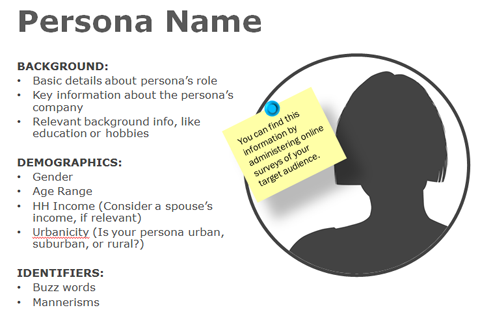
Buyer personas help you define and target the right people, in the right places, at the right times with the right messages.
When you know your target audience’s age, occupation, income, interests, pains, problems, obstacles, habits, likes, dislikes, motivations and objections, then it’s easier and cheaper to target them on social or any other media.
buyer persona graphic
A buyer persona is a fictional character, not a real one!
The more specific you are, the more conversions you’re going to get out of every channel you use to promote your business.

#4: Research Competition

When it comes to social media marketing, researching your competition not only keeps you apprised of their activity, it gives you an idea of what’s working so you can integrate those successful tactics into your own efforts.
Start by compiling a list of at least 3-5 main competitorsSearch which social networks they’re using and analyze their content strategy. Look at their number of fans or followers, posting frequency and time of day.
Also pay attention to the type of content they’re posting and its context (humorous, promotional, etc.) and how they’re responding to their fans.
The most important activity to look at is engagement. Even though page admins are the only ones who can calculate engagement rate on a particular update, you can get a good idea of what they’re seeing.
For example, let’s say you’re looking at a competitor’s last 20-30 Facebook updates. Take the total number of engagement activities for those posts and divide it by the page’s total number of fans. (Engagement activity includes likes, comments, shares, etc.)
You can use that formula on all of your competitors’ social profiles (e.g., on Twitter you can calculate retweets and favorites).
Keep in mind that the calculation is meant to give you a general picture of how the competition is doing so you can compare how you stack up against each other.

#5: Choose Channels and Tactics

Many businesses create accounts on every popular social network without researching which platform will bring the most return. You can avoid wasting your time in the wrong place by using the information from your buyer personas to determine which platform is best for you.
If your prospects or customers tell you they spend 40% of their online time on Facebookand 20% on Twitter, you know which primary and secondary social networks you should focus on.
When your customers are using a specific network, that’s where you need to be—not everywhere else.
Your tactics for each social channel rely on your goals and objectives, as well as the best practices of each platform.
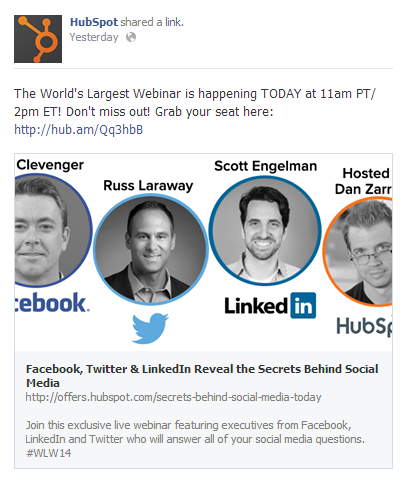
hubspot webinar image
HubSpot’s effective use of Facebook for lead generation.
For example, if your goal is increasing leads and your primary social network is Facebook, some effective tactics are investing in Facebook advertising or promotion campaigns to draw more attention to your lead magnets.

#6: Create a Content Strategy

Content and social media have a symbiotic relationship: Without great content social media is meaningless and without social media nobody will know about your content. Use them together to reach and convert your prospects.
There are three main components to any successful social media content strategy: type of content, time of posting and frequency of posting.
The type of content you should post on each social network relies on form and context. Form is how you present that information—text only, images, links, video, etc.
twitter content type
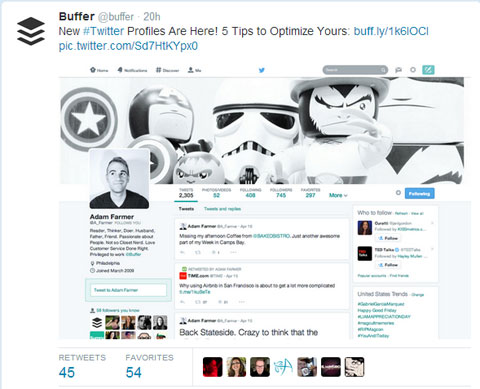
Buffer understands their audience will respond to content that keep them updated on changes in social media.
Context fits with your company voice and platform trends. Should your content be funny, serious, highly detailed and educational or something else?
There are many studies that give you a specific time when you should post on social media. However, I suggest using those studies as guidelines rather than hard rules. Remember, your audience is unique, so you need to test and figure out the best time for yourself.
Posting frequency is as important as the content you share. You don’t want to annoy your fans or followers, do you?
Finding the perfect frequency is crucial because it could mean more engagement for your content or more unlikes and unfollows. Use Facebook Insights to see when your fans are online and engaging with your content.

#7: Allocate Budget and Resources

To budget for social media marketing, look at the tactics you’ve chosen to achieve your business goals and objectives.
Make a comprehensive list of the tools you need (e.g., social media monitoring, email marketing and CRM), services you’ll outsource (e.g., graphic design or video production) and any advertising you’ll purchase. Next to each, include the annual projected cost so you can have a high-level view of what you’re investing in and how it affects your marketing budget.
Many businesses establish their budget first, and then select which tactics fit that budget. I take the opposite approach. I establish a strategy first, and then determine the budget that fits that strategy.
If your strategy execution fees exceed your budget estimate, prioritize your tactics according to their ROI timeframe. The tactics with the fastest ROI (e.g., advertising and social referral) take priority because they generate instant profit you can later invest into long-term tactics (fan acquisition, quality content creation or long-term engagement).

#8: Assign Roles

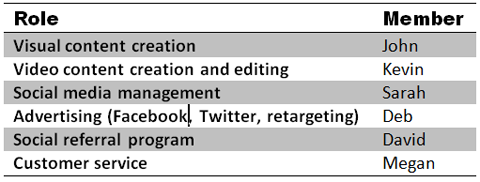
Knowing who’s responsible for what increases productivity and avoids confusion and overlapping efforts. Things may be a bit messy in the beginning, but with time team members will know their roles and what daily tasks they’re responsible for.
social media roles table
An example of assigning roles.
When everyone knows his or her role, it’s time to start planning the execution process. You can either plan daily or weekly. I don’t advise putting a monthly plan together because lots of things will come up and you may end up wasting time adapting to the new changes.
You can use tools like Basecamp or ActiveCollab to manage your team and assign tasks to each member. These tools save you tons of time and help you stay organized.
Your Turn
Your social media marketing strategy isn’t written in stone. As you move forward, you may discover that some tactics are not working as well as you thought they would. Always try to adapt quickly and introduce the new changes to your overall strategy.

What do you think? Do you have a clear social media strategy? What tools do you use to keep your team moving ahead? I would love to hear your thoughts, questions or comments on this process. Please leave them in the comment section below!